PHNOM PENH — December 9, 2025 — Fighting along the Thailand-Cambodia border escalated sharply on Tuesday, with both militaries accusing the other of breaking a fragile, US-supported ceasefire and civilians fleeing frontline areas in the tens of thousands. The renewed violence — triggered by a fatal skirmish late Sunday — has revived long-standing territorial disputes and raised new doubts about the durability of the region’s peace efforts.
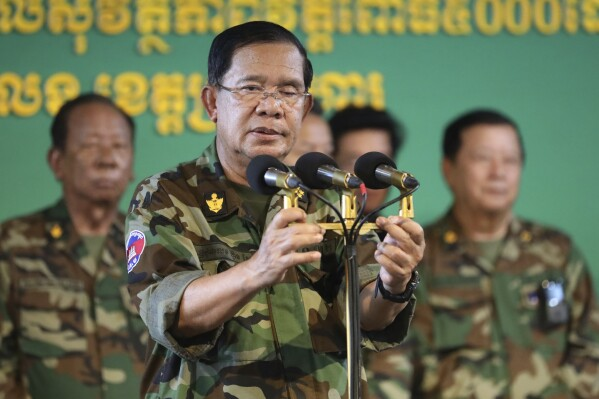
Cambodia’s Senate President Hun Sen, still widely viewed as the country’s de facto leader, vowed to retaliate forcefully as clashes intensified. Thai officials, meanwhile, reported additional military casualties and warned that cross-border shelling had resumed near contested temple sites.
Clashes Shatter the US-Backed Peace Framework
The latest confrontation erupted after a Thai soldier was killed in a Sunday-night exchange of fire, prompting both armies to deploy reinforcements. Malaysia and ASEAN had brokered a ceasefire earlier this year with support from the United States and China, but the fragile accord is now under severe strain.
On Tuesday, Hun Sen accused Thailand of advancing on Cambodian positions, saying Phnom Penh had initially held fire before responding overnight. He argued that focusing counterattacks on advancing Thai units would “weaken and destroy enemy forces,” signaling a hardened military stance.
Cambodia’s armed forces reported seven civilian deaths and at least 20 wounded, underscoring the human toll as fighting spreads across multiple border villages.
Thailand Reports New Casualties as Tensions Rise
Thai authorities confirmed two additional military deaths on Tuesday — one from indirect fire in Surin province and another caused by a grenade blast near the UNESCO-listed Preah Vihear Temple, a flashpoint in the century-old dispute.
Bangkok accused Cambodian artillery units of firing into Sa Kaeo province, though no civilian casualties were reported. Thai Rear Admiral Surasant Kongsiri said naval forces were strengthening defensive positions in the country’s east, signaling preparations for a prolonged standoff.
The long-running dispute centers on several temples and surrounding lands claimed by both nations, with disagreements dating back to a French-drawn colonial map from 1907. Though neither side wants a full war, military officials say national pride and domestic politics continue to inflame tensions.
Recommended Article: Domestic Politics Fuel Rising Tensions Along Thailand–Cambodia Border
Civilians Flee as Frontline Violence Grows
Evacuations expanded rapidly on both sides of the frontier, with Cambodian and Thai officials confirming that tens of thousands of residents had fled their homes. Sporadic fighting in recent years has already led to large-scale displacement, but the intensity of this week’s assaults has sparked fears of a broader conflict.
Local authorities said many evacuees are being sheltered in schools and makeshift camps as artillery exchanges continue intermittently across the rugged border terrain.
Military Strength Imbalance Shapes Regional Dynamics
Thailand’s military dominance looms large over the confrontation. With a defense budget exceeding $5.7 billion and more than 360,000 personnel, Thailand possesses one of Southeast Asia’s strongest air and naval forces.
Cambodia, by comparison, maintains a significantly smaller and lightly equipped force of roughly 124,000 personnel, with no fighter jets and limited armored capabilities. Analysts warn that this imbalance, combined with aggressive domestic political messaging, risks escalating the confrontation beyond its current scope.
Trump-Backed Ceasefire at Risk of Collapse
The renewed violence also threatens the credibility of a peace deal supported by the United States under President Donald Trump. Washington and Beijing had jointly pressured both sides to scale back heavy weapons, reduce hostile rhetoric, and rebuild diplomatic trust.
But compliance has been uneven. Cambodia claims Thailand is holding 18 of its fighters captured during the onset of the ceasefire, while Thailand accuses Cambodia of laying new land mines in contested areas — some of which have recently injured Thai soldiers.
Both governments have engaged in an ongoing propaganda battle, complicating regional mediation efforts.
Centuries-Old Border Dispute Resurfaces
The Cambodia-Thailand border stretches more than 800 kilometers across sparsely populated land. The competing territorial claims surrounding temple complexes such as Preah Vihear have fueled tensions since the 1960s, despite international court rulings aimed at clarifying boundaries.
Analysts say the roots of the conflict go deeper than geopolitics. The temples hold symbolic importance in both cultures, making concessions politically risky for leaders in Phnom Penh and Bangkok.
Uncertain Path Forward as Hostilities Continue
With casualties rising and no sign of de-escalation, the future of the US-backed ceasefire is uncertain. ASEAN is expected to push for emergency consultations, but observers warn that domestic political pressures — especially within Thailand’s powerful military and Cambodia’s leadership circles — may hinder diplomatic progress.
For now, both armies appear entrenched, civilians remain displaced, and the risk of a broader regional crisis is mounting.