Bitcoin Retreats Amid Rising Global Uncertainty
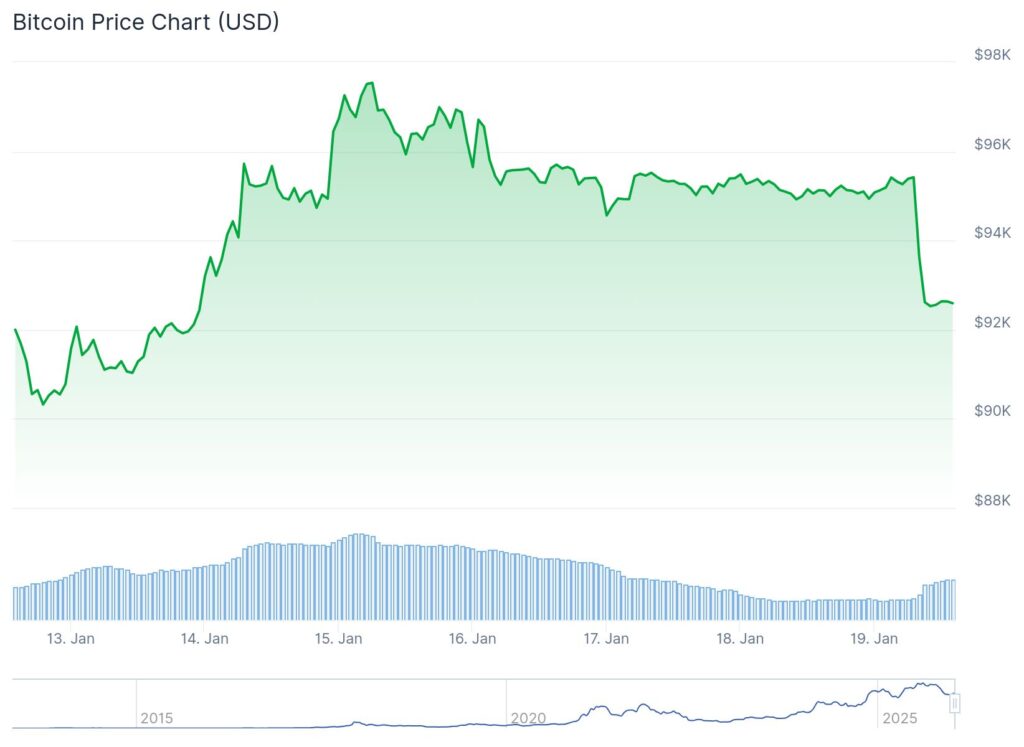
Bitcoin entered January 18, 2026, under renewed selling pressure, slipping below the $92,000 level as global markets reacted to escalating trade tensions. Investors across asset classes reduced exposure to risk-sensitive instruments, and cryptocurrencies were no exception. The pullback marked a shift from the relative stability seen earlier in the month.
The renewed volatility followed fresh rhetoric surrounding potential tariff measures between major economic blocs, which unsettled already cautious investors. As uncertainty increased, Bitcoin’s role as a high-beta asset came back into focus.
Trade Policy Sparks Risk-Off Sentiment
Concerns over international trade policy played a central role in the market’s downturn. Discussions of additional tariffs between the United States and its trading partners raised fears of slower global growth and renewed inflationary pressures.
Such macroeconomic risks typically lead investors to rotate toward safer assets. In this environment, capital flowed into government bonds and gold, while equities and cryptocurrencies experienced selling pressure. Bitcoin’s decline reflected this broader shift in sentiment rather than crypto-specific weakness.
Technical Levels Come Under Pressure
From a technical perspective, the move below $92,000 was significant. That level had acted as a key support zone following recent highs, and its breach triggered short-term selling by momentum-driven traders.
Market participants are now closely watching the $90,000 threshold, which holds both psychological and technical importance. A sustained break below that level could invite further downside testing, while a quick recovery would suggest the move was largely sentiment-driven.
Recommended Article: Bitcoin Volatility Returns as ETF Flows Clash With Macro Uncertainty
Institutional Activity Remains Mixed
Despite the price decline, institutional behavior has not shown signs of panic. Flows into spot Bitcoin investment products have been uneven, with some funds recording modest outflows while others continue to see steady allocations.
This pattern suggests that large investors are adjusting exposure rather than abandoning positions entirely. Many institutions appear to be waiting for greater clarity on macro developments before committing additional capital.
On-Chain Signals Point to Consolidation
On-chain data offers a more nuanced picture than price action alone. Metrics tracking long-term holders indicate that wallets holding Bitcoin for extended periods remain largely inactive, signaling confidence rather than capitulation.
At the same time, increased activity among short-term holders reflects tactical trading around headlines. Historically, this combination of long-term conviction and short-term volatility has preceded periods of consolidation rather than prolonged declines.
Bitcoin’s Role in a Risk-Off Environment
Bitcoin’s performance during risk-off episodes continues to fuel debate about its evolving market role. While often compared to digital gold, Bitcoin still behaves more like a risk asset during periods of macro stress.
That dynamic does not negate its long-term value proposition but highlights the importance of time horizon. Short-term traders react to macro shocks, while longer-term investors focus on structural adoption and monetary trends.
Outlook as Markets Seek Direction
Looking ahead, Bitcoin’s near-term direction will likely hinge on developments in trade policy, inflation data, and central bank communication. Clear signals on tariffs or economic growth could stabilize sentiment and support a rebound.
For now, Bitcoin’s dip below $92,000 underscores its sensitivity to global macro forces. Whether the move evolves into deeper weakness or resolves into sideways consolidation will depend on how quickly uncertainty fades.