

Bitcoin Halving Cuts Mining Revenue Significantly
Bitcoin mining profitability declined sharply after the 2024 halving reduced block rewards by half. Rewards dropped from six point twenty-five Bitcoin to three point one two five, immediately compressing miner revenues.
At the same time, network difficulty continued rising, making it harder and more expensive to mine new blocks. This combination has created one of the toughest environments for miners in recent years.

AI Data Centers Offer Higher Revenue Potential
Artificial intelligence workloads are now offering significantly higher returns compared to traditional Bitcoin mining operations. Data centers focused on AI computing can generate substantially more revenue per megawatt of electricity used.
This shift has made AI infrastructure a highly attractive alternative for companies previously focused on mining. As a result, many firms are redirecting resources toward high-performance computing and AI-related services.
Major Mining Firms Secure Billion-Dollar Deals
Several large mining companies have already secured massive contracts tied to artificial intelligence infrastructure development. These agreements are worth billions and involve partnerships with major technology companies globally.
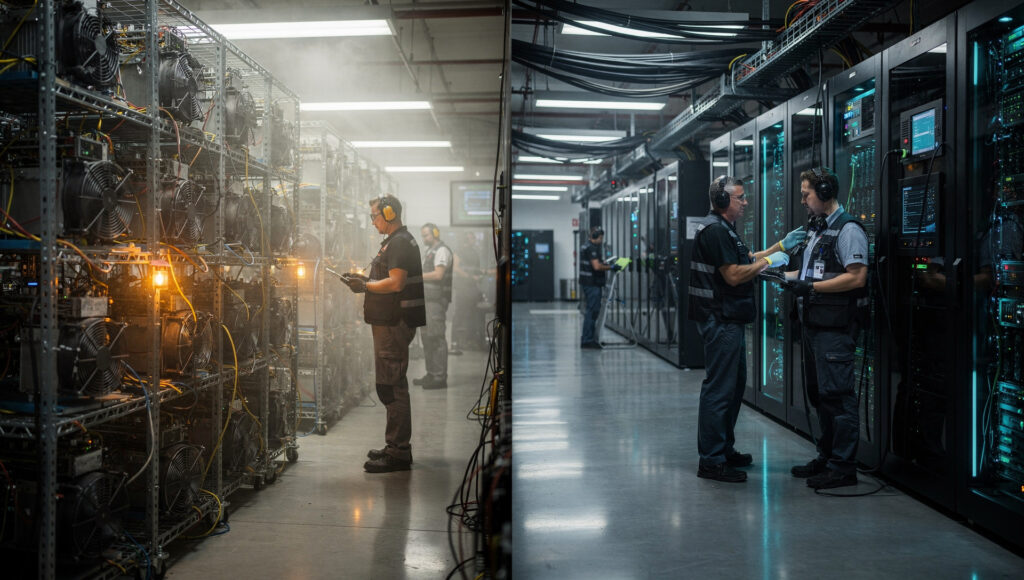
Firms are leveraging existing infrastructure, including power access and cooling systems, to transition into AI services. This allows them to capitalize quickly on growing demand without building entirely new facilities from scratch.
Industry Faces Identity Shift and Strategic Pivot
The rapid transition toward AI has sparked a broader identity shift within the Bitcoin mining industry. Companies that once focused solely on mining are now diversifying into multiple revenue streams beyond cryptocurrency.
This transformation reflects changing market realities and the need for sustainable profitability in competitive environments. Mining is no longer the sole focus, as firms adapt to evolving technological and economic conditions.
Mining Economics Remain Under Pressure
Even before the shift to AI, mining profitability had been under pressure due to rising operational costs. Electricity expenses, hardware upgrades, and increasing competition have all contributed to shrinking profit margins.
With AI offering more stable and higher returns, the economic case for mining has weakened further. This has accelerated the migration of capital and resources away from traditional mining activities.
Network Stability Supported by Difficulty Adjustments
Despite concerns about miners leaving the network, Bitcoin’s protocol includes mechanisms to maintain stability over time. The difficulty adjustment system recalibrates mining difficulty based on network participation levels.
This ensures that block production remains consistent even as miners exit or reduce activity. As a result, Bitcoin’s core functionality continues operating reliably despite shifts in the mining landscape.
Future Depends on Market and Technology Trends
The long-term balance between mining and AI infrastructure will depend on evolving market conditions and technological developments. If Bitcoin prices rise significantly, mining could regain profitability and attract renewed interest.
Conversely, continued growth in AI demand may further accelerate the industry’s transition toward computing services. The sector is likely to evolve into a hybrid model combining both mining and advanced digital infrastructure.