AI Becomes a Collaborative Partner Across Industries
Microsoft has unveiled seven transformative artificial intelligence trends expected to redefine the global technology landscape by 2026. The company emphasized a shift in AI’s role, describing it as moving from a simple analytical tool to a true “partner” that collaborates with humans in work, creativity, problem-solving, and scientific advancement. This evolution is poised to accelerate innovation across medicine, software engineering, environmental science, and quantum computing, unlocking capabilities once viewed as unattainable.
The announcement highlights how AI is increasingly integrated into daily life and business, with the potential to address critical global challenges such as climate change, accurate weather forecasting, early flood detection, and the reduction of carbon emissions. Microsoft said this deepening partnership between humans and AI will be a defining characteristic of the next era of technological progress.

AI Agents Transform the Workplace Through Collaboration
The first trend focuses on AI’s ability to amplify what teams and individuals can accomplish together. Microsoft predicts AI Agents will become digital coworkers capable of supporting data management, content creation, and personalized tasks. Humans will retain strategic and creative control while delegating routine or large-scale operations to AI.
By helping individuals and small teams “punch above their weight,” AI collaboration is expected to shorten production cycles, increase output quality, and unlock greater creative potential across various industries.
Ensuring Security as AI Agents Become Workforce Participants
As AI Agents take on responsibilities traditionally handled by employees, Microsoft stresses the importance of comprehensive safeguards. Each AI system will require a traceable identity, controlled access to information, and strict boundaries for system permissions. The company says AI must be protected from manipulation, misuse, or external attacks—just as organizations secure their human workforces.
Security architecture, Microsoft noted, must be built into AI systems from the start, ensuring autonomous and ambient protection rather than retrofitted solutions.
Recommended Article: South Korea Orders Probe Into Alleged Political Ties With Religious…
AI’s Expanding Role in Closing Global Healthcare Gaps
Microsoft highlighted significant advances in healthcare AI, moving beyond diagnostics into triage, treatment planning, and biomedical research. Tools like BioEmu-1 enable scientists to examine protein structures more quickly, improving drug development. The multimodal model RAD-DINO integrates X-ray imagery with text analysis, offering clinicians faster and more complete radiology assessments.
Another model, FCDD, supports early breast cancer detection by generating MRI heatmaps that pinpoint suspected tumors with higher accuracy and fewer false positives. These healthcare innovations aim to address shortages in medical personnel and improve outcomes across global health systems.
AI Becomes a Core Engine of Scientific Discovery
A major shift anticipated for 2026 is AI’s deeper involvement in scientific research. Beyond summarizing academic papers, AI will help form hypotheses, control experimental tools, and collaborate with human and AI researchers. Microsoft’s MatterGen and MatterSim models are examples, helping scientists design new materials, simulate their performance, and accelerate breakthroughs in clean energy technologies.
Additionally, the Aurora AI model enhances weather and environmental forecasting, providing faster and more accurate predictions critical to climate response, flood mitigation, and resource planning.
Smarter, More Efficient AI Infrastructure Emerges
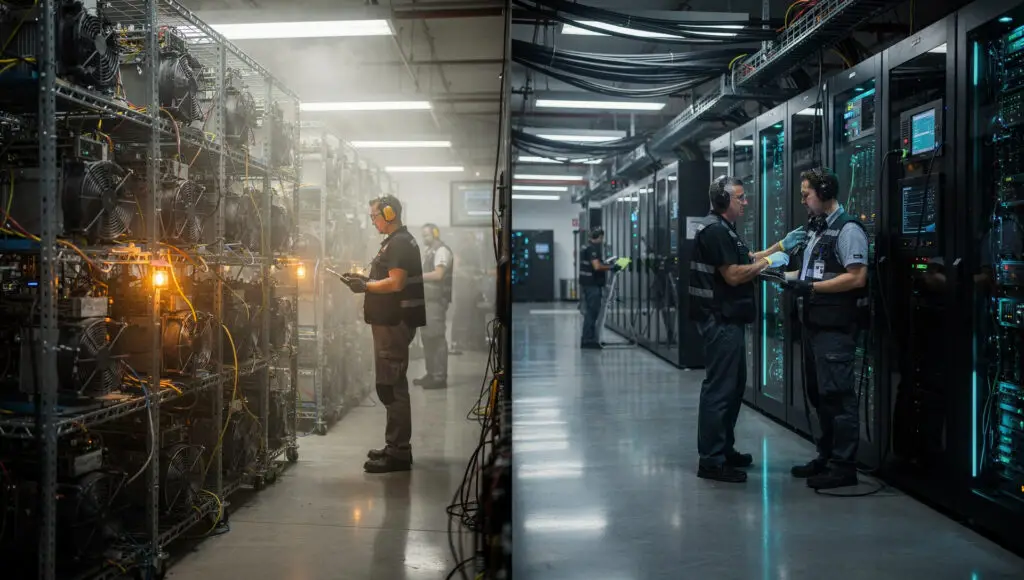
The growth of AI technology will depend less on the number of data centers and more on maximizing computational efficiency. Microsoft predicts the rise of flexible, globally connected AI “superfactories” capable of increasing processing power while reducing energy consumption and operational costs.
The Analog Optical Computer (AOC), which uses light instead of traditional digital components, exemplifies this shift. The AOC demonstrates lower energy usage and faster inference speeds, offering a glimpse of future high-performance AI systems that surpass current GPU limitations.
AI Learns Code and Its Context to Improve Development
As 2026 approaches, Microsoft expects AI systems to understand not only software code but also its broader context—repository history, developer intent, and structural relationships. This “repository intelligence” will enable AI to identify errors sooner, recommend smarter improvements, and automate repetitive coding tasks.
These advancements could lead to faster development cycles and higher-quality software while allowing engineers to focus on innovation rather than maintenance.
Quantum Computing Moves Toward Practical Breakthroughs
Microsoft concluded by highlighting accelerating progress in quantum computing. The world is entering a “years, not decades” period for achieving quantum advantage, where quantum systems solve problems classical computers cannot. Hybrid computing—combining quantum, AI, and supercomputing—will drive this shift.
The company’s Majorana 1 quantum chip, featuring a new topological core architecture, represents a major step toward building scalable and reliable qubits. Combined with AI models such as Aurora, Microsoft believes quantum innovation will play a pivotal role in climate modeling, material discovery, and other global challenges.