Bitcoin’s sharp decline in early February has reinforced a growing sense that the digital asset market has entered a new and more volatile phase. After briefly stabilising near the start of the year, the world’s largest cryptocurrency suffered another steep sell-off, pushing prices to levels not seen since before the late-2024 rally. The move reflects a convergence of political uncertainty, delayed regulation, and a broader global retreat from risk.
The renewed downturn has also altered investor psychology. Instead of viewing dips as buying opportunities, many traders are reassessing exposure altogether, especially as correlations between crypto, equities, and commodities strengthen during periods of stress. This shift marks a meaningful change from the optimism that followed the U.S. election cycle and earlier expectations of regulatory clarity.
Renewed Selling Pressure Pushes Bitcoin Lower
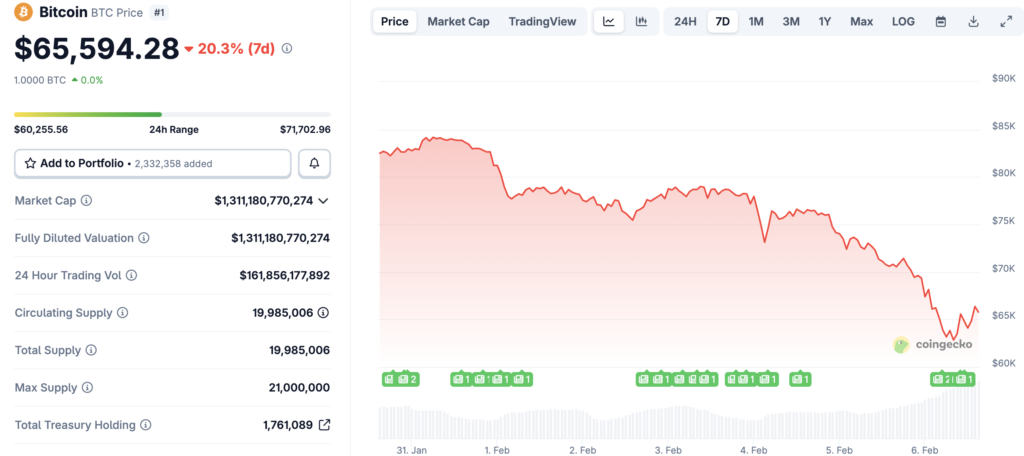
Bitcoin prices fell sharply during the first week of February, extending losses that began in January and accelerating on heavy trading volumes. The move erased a significant portion of gains accumulated during the post-election surge and brought year-to-date losses close to one-third of Bitcoin’s value. Such a drawdown underscores how quickly sentiment can reverse in highly leveraged markets.
Market participants point to forced liquidations and reduced risk appetite as key drivers. As prices fell through technical support levels, automated selling intensified, amplifying downside momentum. This pattern has become increasingly common as crypto markets integrate more closely with global trading systems and institutional strategies.
Political Expectations Fade After Post-Election Rally
Part of Bitcoin’s earlier strength was built on expectations that a second administration under Donald Trump would usher in a more crypto-friendly regulatory environment. Campaign rhetoric and early signals from advisers raised hopes that digital assets would face lighter oversight and clearer legal frameworks in Washington.
Those expectations have since cooled. Legislative proposals aimed at regulating digital asset markets have stalled in the U.S. Senate, caught between competing interests from banks, technology firms, and crypto-native companies. The lack of progress has reintroduced uncertainty, reminding investors that political promises do not always translate into swift policy action.
Recommended Article: Bitcoin Slides Toward $71,000 as Global Risk Appetite Collapses
Regulatory Delays Add Structural Uncertainty
Beyond headline politics, the regulatory environment itself remains fragmented. Agencies continue to debate jurisdiction, enforcement standards, and consumer protection rules, leaving firms and investors without a unified framework. This uncertainty has discouraged long-term capital allocation and encouraged short-term trading behaviour.
Internationally, regulatory divergence adds another layer of complexity. While some jurisdictions push for innovation-friendly rules, others tighten controls, creating an uneven global landscape. For Bitcoin, which trades around the clock across borders, such fragmentation increases volatility and complicates valuation models.
Global Risk-Off Mood Hits Crypto Alongside Equities
Bitcoin’s decline has not occurred in isolation. Global equity markets have also experienced sharp swings, with technology stocks particularly exposed as investors reassess growth expectations and capital spending plans. Major indices in the United States and Asia have posted notable losses, reinforcing a broader “risk-off” environment.
In this context, Bitcoin has behaved less like a safe-haven asset and more like a high-beta risk instrument. As investors reduce exposure to volatile assets, cryptocurrencies have been sold alongside equities, industrial metals, and even some commodities. This behaviour challenges the narrative of Bitcoin as a hedge during periods of macroeconomic stress.
Institutional Participation Changes Market Dynamics
The growing presence of institutional investors has fundamentally altered how Bitcoin trades. Large funds, proprietary trading desks, and algorithmic strategies now account for a substantial share of volume, increasing sensitivity to macro signals such as interest rates, geopolitical developments, and fiscal policy.
While institutional participation has added liquidity and legitimacy, it has also increased correlation with traditional markets. When global funds rebalance portfolios or reduce leverage, Bitcoin is increasingly caught in the same flows that affect stocks and bonds. This integration helps explain the speed and scale of recent price movements.
Questions Emerge Around Crypto’s Long-Term Narrative
The latest sell-off has reignited debate about Bitcoin’s long-term role in the financial system. Supporters argue that volatility is a feature, not a flaw, and that adoption trends, network security, and supply constraints remain intact. Critics counter that repeated boom-and-bust cycles undermine Bitcoin’s usefulness as a store of value.
For many investors, the truth lies somewhere in between. Bitcoin continues to evolve, but its maturation has not eliminated risk. Instead, it has shifted the sources of volatility from purely crypto-specific events to a mix of macroeconomic and political factors.
What the Current Downturn Signals for 2026
Looking ahead, Bitcoin’s trajectory will likely depend on several interlinked developments. Regulatory clarity in the United States could restore confidence if lawmakers deliver a coherent framework. Conversely, prolonged gridlock may keep investors cautious and cap upside potential.
At the same time, global economic conditions will play a decisive role. If inflation stabilises and growth expectations improve, risk appetite could return, benefiting digital assets. Until then, Bitcoin appears set to trade in a more fragile environment, where optimism must contend with political reality, regulatory delays, and shifting market structure.