


Trump’s Pro-Crypto Policy Drives Market Sentiment
Bitcoin markets opened the year under unusual political scrutiny. With U.S. President Donald Trump actively promoting crypto-friendly policy initiatives, traders and institutional investors alike have been parsing political developments for clues on how regulation might shape digital asset adoption.
Over the past week, Trump’s public comments at forums such as the World Economic Forum — where he suggested that broad crypto legislation could soon be passed — helped spur renewed interest in Bitcoin as a politically relevant asset class. These signals reinforced the narrative that Washington could formalize long-sought regulatory clarity for crypto markets, a theme that has boosted sentiment among some long-term holders and institutional participants.
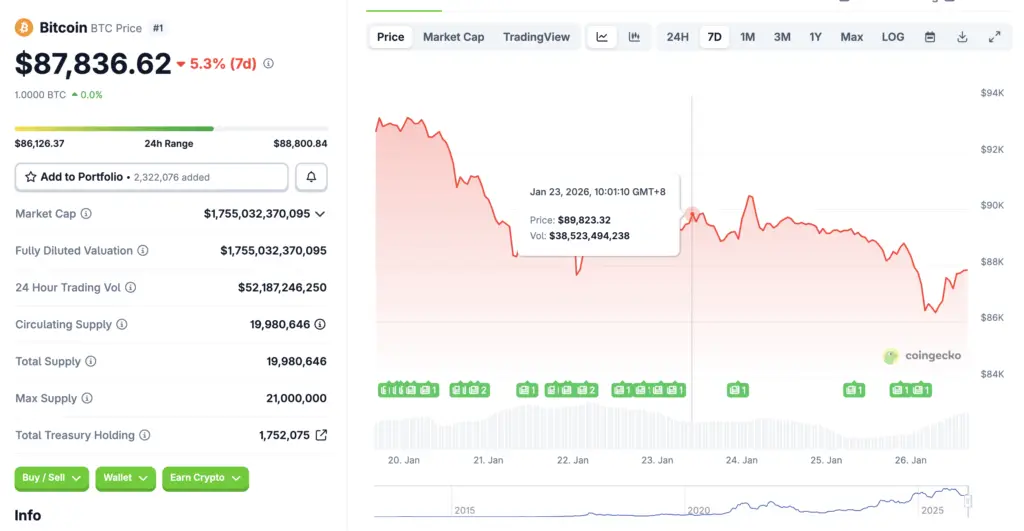
Price Action Reflects Political Tailwinds and Technical Stress
Despite bullish political narratives, price action has shown fragility. Bitcoin has struggled to sustain levels above key technical thresholds, trading in a volatile range as macro and policy dynamics tug in opposing directions.
The dichotomy is stark: on one hand, positive regulatory hints and Trump’s crypto advocacy speak to long-term structural opportunity. On the other hand, a lack of immediate legislative results and mixed technical signals have kept short-term traders cautious. This tension has produced heightened volatility, with sharp intraday swings rather than orderly trending behavior.
Regulatory Clarity vs. Short-Term Uncertainty
A central question for the Bitcoin market remains whether political support can be translated into concrete regulatory frameworks. Trump’s endorsement of broad crypto laws — if it materializes — could provide much-needed clarity for institutional capital, potentially drawing new investors into the space.
However, details matter. Even supportive rhetoric does not guarantee timely action in Congress, and market participants are well aware of how legislative timelines can slip. Moreover, a recent draft of crypto regulatory reform remains under debate in the U.S. Senate, with industry groups and banking lobbies pushing competing visions for digital asset oversight.
This regulatory limbo has made some buyers hesitant to commit capital aggressively, resulting in choppy price action. Traders appear to be treating political signals as conditional rather than definitive catalysts — meaning Bitcoin responds to the prospect of policy improvements without fully pricing them in until legislative signals firm.
Recommended Article: Bitcoin Liquidity Shifts as Asia Drives Overnight Trading Volumes
Meme Coins and Political Branding Influence Speculation
Adding to the political crypto narrative, Trump’s own association with crypto ventures — including the decline of the $TRUMP memecoin — has highlighted the risks of political branding in digital assets. That token has lost substantial value over the past year, underscoring how speculative elements tied to political figures can decouple from broader market fundamentals.
The memecoin’s trajectory provides a cautionary tale about conflating political momentum with sustainable value creation. While political advocacy can raise crypto’s profile, market participants are pushing for more meaningful drivers like regulation, institutional adoption, and macro alignment.
Institutional Interest Holds a Fragile Footing
There are early signs of institutional interest tied to political developments. Major financial firms have explored offering regulated crypto exposure through private banking channels — a shift that reflects growing demand from high-net-worth clients seeking diversified portfolios.
Such institutional engagement is not purely speculative; it reflects a recognition that regulated access and compliance frameworks could be on the horizon. However, these initiatives are early stage and often contingent on regulatory clarity that has yet to materialize.
Macro Pressures Add to Risk Sentiment
Beyond domestic politics, broader macro trends are weighing on Bitcoin. Rising yields in bond markets, geopolitical tensions, and risk-off sentiment in equities have nudged investors toward traditional safe havens like gold. Bitcoin, despite its “digital gold” narrative, has not consistently mirrored that behavior, instead trading more like other risk assets when macro stress increases.
This dynamic complicates the picture for traders who hoped political support might offset broader financial headwinds. Instead, Bitcoin’s price action reflects a balancing act between political optimism and economic reality.
What Traders Are Watching Next
Looking ahead, market participants are closely watching a few key factors:
* 1. Legislative Progress: Whether Congress advances clear crypto laws in the coming months — and whether Trump actively pushes these over the finish line — will be a central driver of confidence.
* 2. Regulatory Signals: Actions by the U.S. Securities and Exchange Commission and other regulators will be monitored for signs of enforcement restraint or supportive frameworks.
* 3. Institutional Flows: Continued interest from wealth managers and banking institutions could add liquidity and deepen markets, but only if regulatory clarity persists.
* 4. Macro Context: Broader market moves, especially in bonds and equities, will influence risk appetite and determine whether Bitcoin trades as a hedge or remains tethered to risk assets.
Volatility Reflects Political Transition
Bitcoin’s current environment — marked by elevated political relevance, mixed legislative signals, and macro uncertainty — underscores how price behavior in early 2026 may be tied as much to governance narratives as to pure technical levels.
For investors, the evolving story highlights that political endorsement can kindle interest, but durable price highs will likely require clear regulatory outcomes and institutional participation beyond rhetoric.