Bitcoin’s Calm Start to 2026 Begins to Fracture
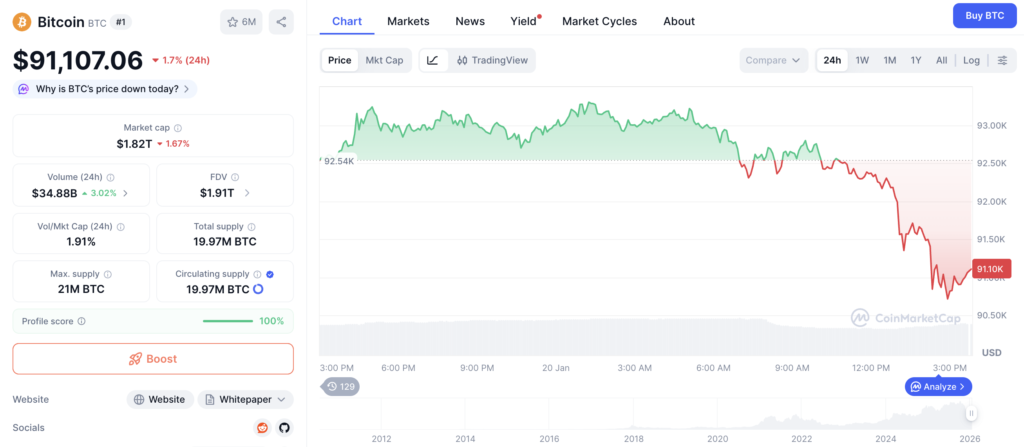
Bitcoin entered 2026 with an unusually stable trading range following a powerful rally in the second half of 2025. Prices hovered near record levels, reinforcing confidence that the market had entered a mature phase supported by institutional demand. That calm, however, began to fracture in mid-January as volatility returned and price swings widened across major trading venues.
The shift reflects a broader reassessment of risk rather than a sudden collapse in confidence. Investors are increasingly balancing long-term conviction against near-term uncertainty, particularly as macroeconomic signals remain mixed and geopolitical tensions re-enter market narratives.
Profit-Taking Emerges After Historic Gains
After one of Bitcoin’s strongest annual performances on record, profit-taking has become a natural force. Long-term holders who accumulated during previous market cycles are gradually realizing gains, especially as Bitcoin struggles to decisively break into higher price territory.
This behavior does not suggest panic or capitulation. Instead, it mirrors patterns seen after previous bull runs, where consolidation and distribution phases follow rapid appreciation before the next structural move takes shape.
Macro Policy Signals Reassert Influence
Macroeconomic conditions remain a dominant factor shaping Bitcoin’s short-term direction. Central banks have tempered expectations for rapid interest rate cuts, reinforcing a “higher for longer” environment that pressures speculative assets.
As institutional participation grows, Bitcoin has become more sensitive to real yields, inflation expectations, and central bank guidance. This linkage has tightened correlations with broader financial markets, particularly during periods of policy uncertainty.
Recommended Article: Bitcoin Slips Below $92,000 as Trade Tensions Renew Market Volatility
ETF Flows Reflect Portfolio Rebalancing
Spot Bitcoin exchange-traded funds continue to play a central role in price dynamics. January flows have been uneven, with some funds recording modest inflows while others experience short-term redemptions.
Rather than signaling an exit from Bitcoin exposure, these movements suggest portfolio rebalancing. Institutions appear to be adjusting allocations based on risk tolerance, performance benchmarks, and broader asset allocation strategies.
Derivatives Markets Amplify Short-Term Moves
Futures and options markets have contributed to heightened volatility. Short-term leverage has increased, particularly among traders positioning for directional moves tied to macro headlines.
As leverage builds, price movements become more reactive, increasing the likelihood of liquidation cascades during sharp intraday swings. This dynamic has exaggerated volatility without fundamentally altering long-term supply-demand dynamics.
On-Chain Data Shows Structural Resilience
Despite recent turbulence, on-chain indicators remain constructive. Long-term holder supply has remained largely stable, with limited evidence of widespread distribution. In some cohorts, accumulation has even resumed during price pullbacks.
Historically, this pattern has preceded periods of consolidation rather than sustained downtrends, reinforcing the view that current volatility reflects digestion rather than deterioration.
What Lies Ahead for Bitcoin in Early 2026
Bitcoin’s near-term outlook depends heavily on macro clarity. Clearer signals on interest rates, trade policy, and global growth could catalyze renewed momentum, while prolonged uncertainty may extend consolidation.
For now, volatility appears to be a feature of a maturing market rather than a sign of structural weakness. Bitcoin remains firmly embedded in global financial discussions, with long-term adoption trends continuing to support its strategic relevance.