

Julian Ross, an electronics engineer who tests devices over time, evaluates mid-range smartphones based on durability, heat performance, and everyday use, not just their specs at launch. From a lab testing view, adding features like a stylus creates more parts that can wear out, so long-term testing is needed to check how accurately it works, how parts hold up, and how reliable it stays over time. In markets like India, where price and long-term use matter most, factors like battery life, heat control, and how easy a phone is to repair often matter more than flashy features.
Alcatel V3 Ultra Targets India Mid-Range Market With Stylus Focus
The re-entry of Alcatel into India with the V3 Ultra reflects a strategic attempt to regain relevance in one of the world’s most competitive smartphone markets. Based on early product teasers and industry reports, the move targets the mid-range segment, where feature differentiation and aggressive pricing are critical for market entry.
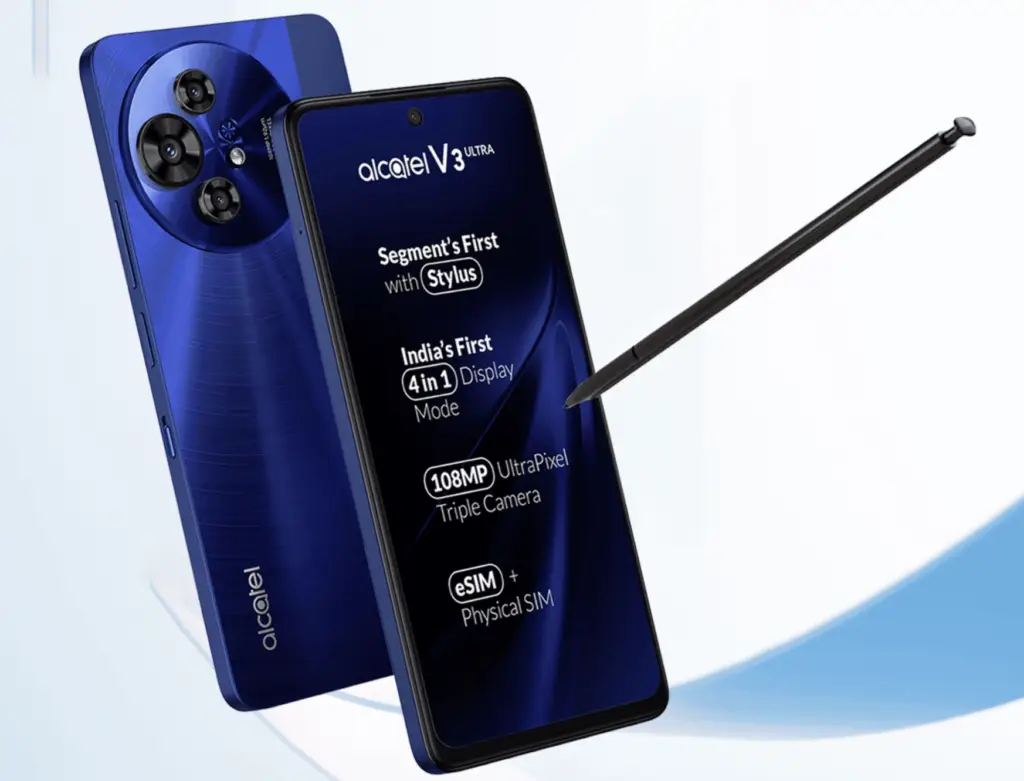
Image source: Gogi Tech
Why is Alcatel relaunching in India now?
India represents a high-volume, price-sensitive market with strong growth potential and increasing demand for feature-rich smartphones.
In our analysis of market conditions and available data:
- India remains one of the fastest-growing smartphone markets globally, according to industry shipment reports
- Mid-range devices dominate due to a balance between affordability and functionality
- Government initiatives supporting domestic manufacturing encourage brands to localize production
The positioning of the brand around a “Born in France, Now in India” narrative suggests alignment with both global branding and local market expectations.
Strategic reasons for market entry:
- Large and expanding consumer base
- Strong demand for value-driven devices
- Incentives for domestic assembly and manufacturing
- Opportunity to rebuild brand presence in emerging markets
What do early reports reveal about the V3 Ultra?
Initial information about the device comes from company teasers and early coverage, rather than full confirmed specifications.
In our observation of reported details:
- The device is expected to feature a triple-camera setup with a circular module
- Stylus support is indicated, suggesting productivity-oriented use cases
- Design similarities have been noted with devices such as the TCL 50 Pro NxtPaper
Early reports suggest the device may include:
- A large Full HD+ display suited for media consumption
- A mid-range chipset, potentially from MediaTek
- A high-resolution primary camera system
These features position the V3 Ultra as a hybrid device targeting both entertainment and productivity users, though full specifications remain subject to official confirmation.
How does this impact the Indian smartphone market?
India’s smartphone sector is highly competitive, with strong presence from major players such as Samsung Electronics, Xiaomi, and Realme.
In our analysis of competitive dynamics:
- New entrants must deliver strong price-to-performance ratios to gain traction
- Feature differentiation, such as stylus support, can create niche positioning
- Branding and local manufacturing narratives influence purchasing decisions
Market transmission effects:
- Intensified competition in the mid-range segment
- Pressure on incumbents to enhance feature offerings
- Potential emergence of stylus-enabled niche devices
- Reinforcement of India’s role as a global smartphone battleground
Market Entry Factors and Competitive Impact Framework
Based on market trends, early product information, and competitive positioning, the following framework summarizes the potential impact of Alcatel’s re-entry.
| Indicator | Current Signal | Market Impact (India Smartphone Sector) |
|---|---|---|
| Market Entry Strategy | India-focused launch | Intensified competition |
| Product Differentiation | Stylus support | Niche positioning opportunity |
| Pricing Pressure | Expected high | Margin compression across brands |
| Brand Recognition | Rebuilding phase | Gradual adoption curve |
| Local Manufacturing Push | Strengthening | Alignment with policy incentives |
| Feature Competition | Increasing | Faster innovation cycles |
Can Alcatel compete against established brands?
The competitive landscape presents significant challenges for re-entry.
In our assessment:
- Established brands benefit from extensive distribution networks
- Brand loyalty in India is highly competitive and price-sensitive
- After-sales service and support infrastructure will be critical
However, differentiation through features such as stylus support may allow Alcatel to target specific user segments.
Key competitive hurdles:
- Competing against aggressive pricing strategies
- Rebuilding consumer trust in a returning brand
- Securing strong online and offline distribution channels
Why does stylus support matter in this segment?
Stylus functionality is relatively uncommon in mid-range smartphones, making it a potential differentiator.
In our observation of usage trends:
- Stylus input appeals to students, professionals, and productivity-focused users
- It enables differentiation without relying solely on performance specifications
- It may attract niche segments underserved by mainstream devices
However, from a hardware perspective, stylus integration introduces additional durability considerations, including wear on input surfaces and long-term accuracy of digitizer components.
What should consumers and investors monitor next?
The success of the V3 Ultra will depend on execution rather than initial positioning.
In our analysis, key indicators include:
- Official confirmation of pricing, specifications, and availability
- Real-world performance in battery life, thermals, and durability
- Early consumer feedback and market reception
- Expansion strategy beyond India into other emerging markets
The broader implication is that legacy brands are attempting to re-enter through high-growth markets, where barriers to entry are lower but sustained success depends on product reliability, ecosystem support, and competitive pricing.