

Bitcoin Rebounds After Months of Market Decline
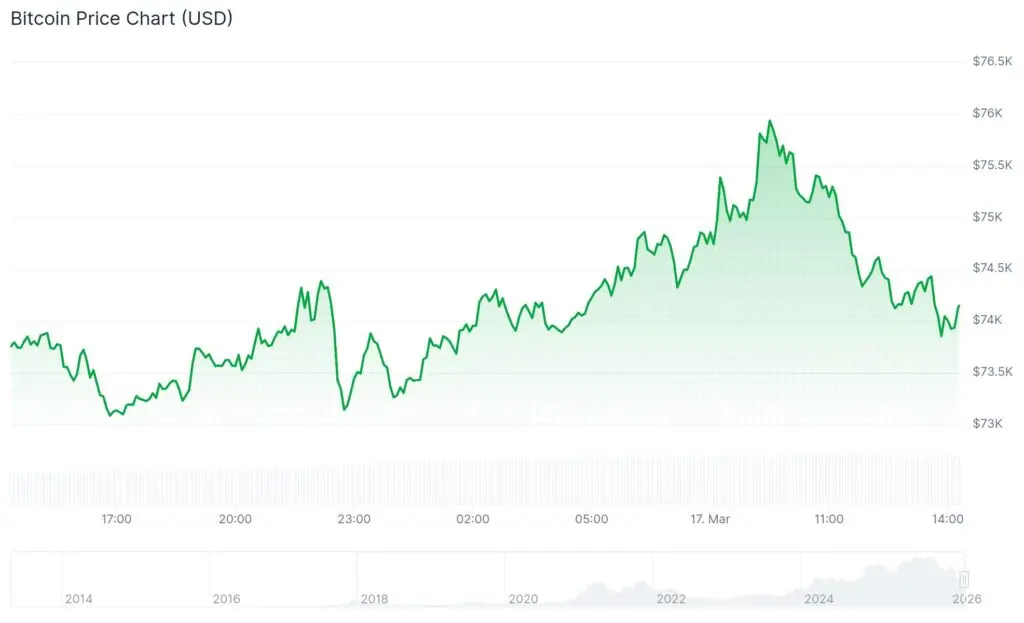
Bitcoin has recently shown signs of recovery after experiencing a prolonged decline over several months. The leading cryptocurrency had dropped significantly from its peak near $126,000, falling close to the $70,000 level.
This sharp correction caused many investors to question its long-term stability and role in financial markets. However, recent geopolitical developments have sparked renewed interest in Bitcoin as a potential safe-haven asset.
Market sentiment has shifted quickly, reflecting how volatile and reactive cryptocurrency markets can be during uncertain times. Investors are once again evaluating Bitcoin’s ability to withstand macroeconomic and geopolitical pressures.
Safe Haven Narrative Gains Momentum Again
The idea of Bitcoin as a safe-haven asset is not new but has recently regained attention among investors. During periods of economic uncertainty, assets like gold have traditionally been used to preserve wealth.
Bitcoin has often been described as “digital gold” due to its limited supply and decentralized nature. This narrative gained traction as institutional investors began including Bitcoin in diversified portfolios.
However, its high volatility has previously challenged this perception, especially during periods of market downturns. The recent rebound suggests that some investors are reconsidering its role as a hedge against global instability.
Comparison Between Bitcoin and Gold Intensifies
The comparison between Bitcoin and gold has become increasingly relevant in recent months. While gold has performed strongly, rising significantly over the past year, Bitcoin has lagged behind its previous highs.
This divergence led many analysts to question whether Bitcoin could truly function as a store of value. Gold’s stability and long-standing reputation continue to make it a preferred safe-haven asset.
Despite this, Bitcoin’s recent price recovery indicates that the gap between the two assets may begin to narrow. If this trend continues, Bitcoin could strengthen its position as a digital alternative to gold.
Geopolitical Tensions Drive Market Behavior
Recent geopolitical tensions, particularly involving conflict in the Middle East, have played a key role in shifting market dynamics. These events often trigger uncertainty, prompting investors to seek safer assets.
Initially, Bitcoin’s price dropped sharply as markets reacted to escalating conflict and rising oil prices. This response aligned with broader risk-off sentiment across global financial markets.
However, Bitcoin quickly rebounded, suggesting that investors may still view it as a potential hedge once initial panic subsides. This pattern mirrors behavior observed during previous financial shocks.
Institutional Influence Shapes Bitcoin Trends
Large financial institutions are playing an increasingly important role in shaping Bitcoin’s market performance. Firms such as BlackRock have analyzed patterns in investor behavior following major economic disruptions.
According to research, capital often flows into gold first during periods of uncertainty before gradually moving into Bitcoin. This transition reflects growing confidence in digital assets over time.
Institutional participation has also contributed to Bitcoin’s legitimacy as an asset class. As more institutions allocate funds to cryptocurrencies, market dynamics continue to evolve rapidly.
Risks of a Potential Bull Trap Remain
Despite the recent price recovery, some analysts warn that Bitcoin could be experiencing a temporary rally known as a bull trap. In such scenarios, prices rise briefly before falling again, trapping new investors.
This risk highlights the importance of cautious investment strategies in highly volatile markets. Bitcoin’s price movements can be influenced by both macroeconomic factors and speculative trading behavior.
Investors must carefully evaluate whether the current momentum represents a sustainable trend or a short-term reaction. Understanding these risks is essential for making informed investment decisions.
Bitcoin May Still Be Undervalued at Current Levels
At its current price near $70,000, some analysts believe Bitcoin could be undervalued relative to its long-term potential. If it regains its safe-haven status, demand for the asset could increase significantly.
The combination of limited supply and growing institutional adoption supports the argument for higher future valuations. Additionally, ongoing geopolitical uncertainty may continue to drive interest in alternative assets.
While Bitcoin remains inherently risky, its evolving role in global financial markets cannot be ignored. For investors willing to accept volatility, it may represent a compelling opportunity in uncertain times.