Ethereum’s Sharpest Decline in Years Shakes Market Confidence
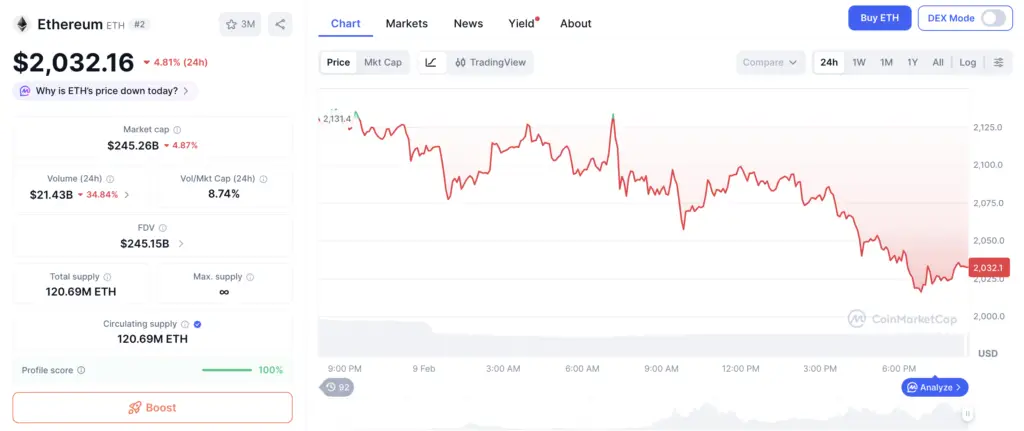
Ethereum has suffered one of its most aggressive sell-offs in recent history, dropping nearly forty percent in just over ten days. The decline pushed prices briefly below the psychologically important $2,000 level, intensifying fear across the broader crypto market and triggering forced liquidations among highly leveraged players.
Market data shows that Ethereum’s fall coincided with weakening liquidity conditions, falling derivatives funding rates, and heightened macro uncertainty. As Bitcoin volatility increased and risk appetite faded globally, Ethereum bore the brunt of investor deleveraging.
Whale Capitulation Signals a Turning Point
One of the most closely watched developments during the sell-off was the capitulation of Trend Research, a large on-chain whale that had accumulated nearly 800,000 ETH using borrowed funds from Binance. As prices approached liquidation thresholds, the firm deposited more than 770,000 ETH back to the exchange, realizing losses estimated at roughly $747 million.
Such large-scale unwinding events often mark moments of extreme stress. Historically, forced exits by dominant market participants tend to coincide with late-stage sell-offs rather than the beginning of prolonged downturns.
Retail Distribution Adds to Downward Pressure
Beyond whales, smaller holders also contributed to the decline. On-chain analytics show wallets holding between 100 and 10,000 ETH distributed more than 800,000 coins over the past week. This broad-based selling reflected panic among retail and mid-sized investors responding to falling prices and negative sentiment.
When Ethereum dropped below its realized price, meaning the average cost basis of holders, selling pressure accelerated further. Investors faced with unrealized losses often choose to exit, amplifying volatility during downturns.
Recommended Article: Ethereum’s Long Descent Shows How DeFi Cycles Shape Crypto Prices
Institutional Exposure Raises Stakes
Ethereum-focused treasury firm BitMine Immersion has also drawn attention after reporting unrealized losses exceeding $7 billion on its ETH holdings. Despite the drawdown, BitMine Chairman Thomas Lee argued that such declines have historically created attractive long-term entry points.
Lee noted that Ethereum has experienced drawdowns exceeding sixty percent multiple times over the past eight years, often followed by strong rebounds. His comments helped stabilize sentiment, suggesting that structural demand for Ethereum remains intact despite short-term price damage.
Ethereum’s Role Beyond Price Action
Support for Ethereum’s long-term relevance also came from co-founder Vitalik Buterin, who emphasized that ETH functions as both a store of value and the backbone of decentralized applications. Unlike purely monetary cryptocurrencies, Ethereum underpins decentralized finance, NFTs, and smart contract infrastructure.
This utility-driven demand differentiates Ethereum from speculative assets, reinforcing the argument that price volatility does not necessarily reflect weakening fundamentals. Activity across decentralized exchanges, staking protocols, and layer-two networks remains resilient despite market stress.
Technical Levels Hint at Potential Reversal
From a technical perspective, Ethereum found support near $1,740, a level that has historically attracted buyers. Following the bounce, prices tested resistance around $2,100, with analysts identifying $2,380 as the next upside target if momentum builds.
Indicators such as the Relative Strength Index and Stochastic Oscillator have begun to recover from oversold conditions. While these signals do not guarantee a reversal, they suggest that bearish momentum may be slowing after an intense liquidation-driven phase.
What Comes Next for Ethereum Investors
Ethereum’s outlook now hinges on whether selling pressure continues or fades as weak hands exit the market. If leverage remains subdued and macro conditions stabilize, the groundwork for a recovery could form rapidly, consistent with previous V-shaped rebounds.
However, renewed ETF outflows, tightening financial conditions, or further whale liquidations could delay any sustained recovery. For now, Ethereum stands at a critical crossroads where fear, fundamentals, and long-term conviction collide.