

Clara Whitmore, an investigative journalist with decades of experience covering geopolitical negotiations and financial crises, views the recent meeting between Donald Trump and Vladimir Putin as a perception-driven event rather than a substantive diplomatic breakthrough. In our analysis of past high-level negotiations, extended discussions without concrete outcomes often indicate strategic positioning, where narrative control becomes as important as policy results. While official statements emphasize “progress,” market participants are increasingly focused on underlying power dynamics and negotiation leverage.
US–Russia Talks Signal Shifting Risk Without Clear Resolution
No ceasefire was reached, but market behavior suggests investors are already adjusting geopolitical risk expectations tied to U.S. leadership strategy. Based on public remarks from officials including Keir Starmer and broader diplomatic signals, the meeting is being interpreted less as a resolution mechanism and more as a directional indicator for future negotiations.
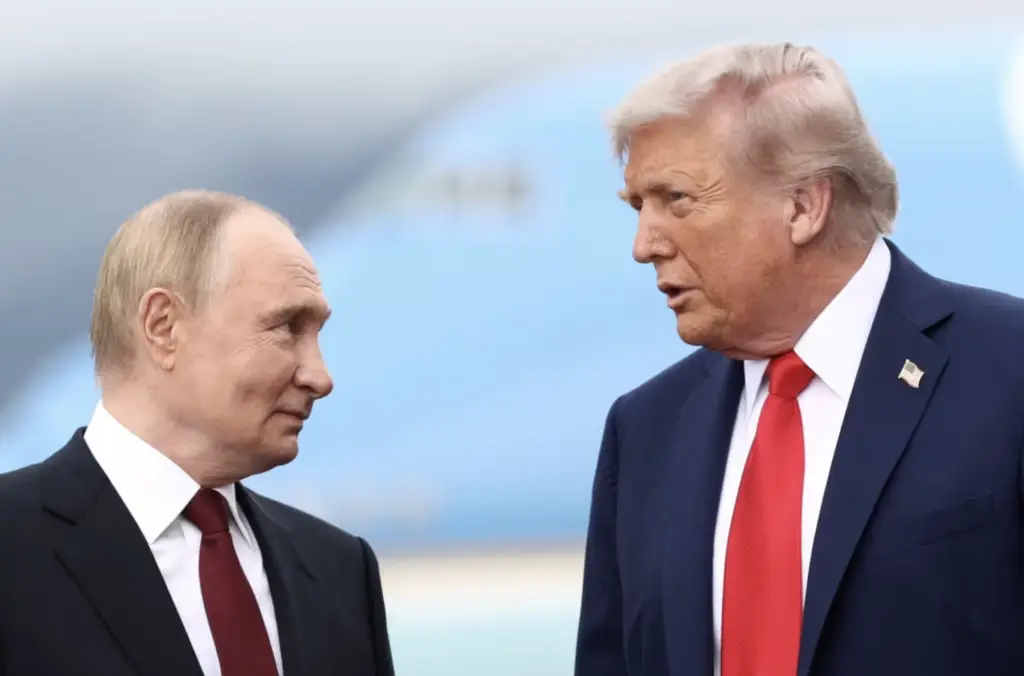
Image source: CNN
Did the Trump–Putin talks move the conflict toward resolution?
From a political perspective, official statements referenced progress, but lacked detail on substantive agreements. Market interpretation has been more cautious, reflecting uncertainty rather than confirmation of de-escalation.
Despite the absence of a formal agreement, several signals emerged:
- Negotiations extended for several hours, indicating continued engagement
- Both sides referenced progress without specifying concessions
- Core issues, including territorial arrangements, remain unresolved
In our view, this creates a transitional scenario where markets begin to price potential de-escalation but stop short of fully discounting geopolitical risk.
Why are markets focused on US leadership signals?
U.S. involvement remains central to the trajectory of the conflict due to its influence over sanctions policy, defense coordination, and global capital flows. Statements from U.S. officials and allied governments are closely monitored as indicators of policy direction.
In our analysis of global market dynamics:
- U.S. policy determines the scale and enforcement of financial sanctions
- It shapes NATO coordination and European defense positioning
- It influences global commodity markets, particularly energy and agriculture
Institutions such as NATO and broader Western alliances reinforce the importance of U.S. leadership signals in shaping investor expectations.
How does this impact US equities, energy, and risk sentiment?
Geopolitical developments tied to U.S. diplomacy transmit quickly into financial markets. Market reaction suggests a cautious recalibration rather than a full shift toward risk-on positioning.
In our analysis of U.S. market behavior:
- Potential de-escalation reduces extreme volatility in energy markets
- Defense sector equities respond to expectations of conflict duration
- Broader indices react positively to reduced tail-risk scenarios
However, the absence of a concrete agreement sustains a neutral-to-cautious bias.
Market transmission channels:
- Energy markets adjust based on expectations of conflict duration
- Defense stocks reprice according to military spending outlook
- Equity indices respond to geopolitical stability signals
- Safe-haven assets remain supported amid uncertainty
Geopolitical Signals and U.S. Market Impact Framework
Based on official statements, diplomatic signals, and observed market behavior, the following framework summarizes how current developments are influencing asset pricing and risk sentiment.
| Indicator | Current Signal | Market Impact (US Assets) |
|---|---|---|
| Ceasefire Progress | No agreement | Neutral to cautious sentiment |
| US Diplomatic Engagement | Active | Reduced extreme downside risk |
| Sanctions Outlook | Ongoing | Energy and commodity volatility |
| Ukraine Negotiation Role | Limited clarity | Persistent political risk premium |
| Security Guarantees | Under discussion | Defense sector sensitivity |
| Russia Strategic Position | Unchanged | Prolonged uncertainty pricing |
What risks remain unresolved after the talks?
The absence of Ukraine’s direct participation in initial discussions introduces structural uncertainty into the negotiation process. According to statements from Volodymyr Zelensky, any agreement without Ukrainian involvement raises concerns about legitimacy and long-term stability.
We identify two primary unresolved risks:
- Potential pressure on Ukraine to accept unfavorable terms
- Extended negotiations that may benefit Russia’s strategic positioning
These factors prevent markets from fully pricing in a resolution scenario and sustain a geopolitical risk premium.
Why are European leaders taking a cautious stance?
European leaders have emphasized the need for a durable and balanced resolution rather than a rapid agreement. Their position reflects both security concerns and broader geopolitical considerations.
In our assessment, this stance is driven by:
- Concerns over territorial concessions and long-term sovereignty
- Commitment to maintaining Ukraine’s defensive capabilities
- Desire to avoid precedents that could encourage future aggression
This creates a divergence between short-term negotiation momentum and long-term strategic stability.
How should investors interpret progress without a deal?
In our view, this represents a transitional phase in market signaling rather than a definitive shift in geopolitical risk.
Investors are likely to:
- Avoid aggressive repositioning until clearer outcomes emerge
- Maintain exposure to defensive sectors and hedging strategies
- Monitor upcoming negotiations, particularly those involving Ukraine directly
The key insight is that progress alone does not eliminate risk, it narrows the range of possible outcomes.
Can diplomacy reduce market volatility in the near term?
Short-term volatility is driven less by final outcomes and more by evolving expectations. Continued dialogue can reduce extreme downside scenarios, but the absence of resolution sustains baseline uncertainty.
We observe that:
- Ongoing negotiations reduce tail-risk scenarios
- Lack of concrete agreements maintains market caution
- Mixed signals produce uneven reactions across asset classes
For now, markets remain in a holding pattern, responding to incremental developments rather than committing to a clear directional shift.