

Nissan and Wayve Announce Breakthrough AI Partnership
Nissan has entered a landmark partnership with British autonomous driving startup Wayve to integrate advanced AI systems into future vehicle models. The agreement, announced on December 10, 2025, represents Wayve’s first mass-scale deal with a global automaker and signals a major leap forward in real-time autonomous driving technology.
The collaboration centers on Wayve’s software-driven approach, which differs from traditional systems by avoiding reliance on pre-programmed maps. Instead, the technology uses artificial intelligence to interpret surroundings, adapt to new conditions, and navigate streets dynamically.
A New Model for Real-Time Autonomous Navigation
Wayve’s AI system is designed to learn from diverse driving environments and respond instantly to unexpected events. The company has been testing the technology under human supervision in London, Tokyo, and multiple international locations.
According to Wayve CEO Alex Kendall, the goal is to develop an autonomy platform that works across global markets rather than being limited to narrow geographic zones. He highlighted that the software-based system allows automakers like Nissan to integrate the technology with whichever sensors, cameras, or hardware suit their vehicle strategies.
Nissan Expands Its ProPILOT Vision With Wayve AI Integration
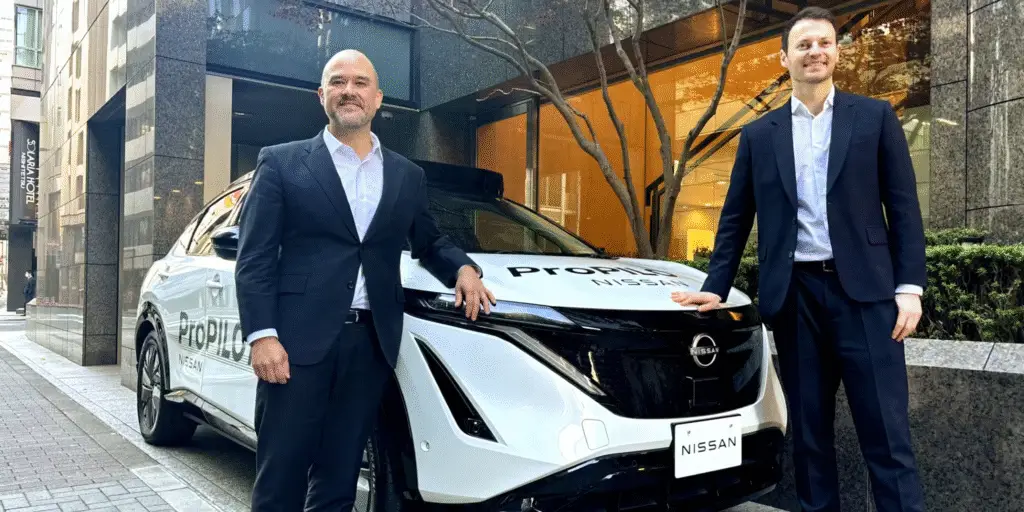
The partnership will support the advancement of Nissan’s ProPILOT driver-assistance program. Nissan has committed to embedding Wayve’s AI into its next generation of ProPILOT features, enabling vehicles to process road conditions, obstacles, and traffic flow more intelligently.
Nissan plans to launch the first vehicle equipped with this upgraded system in Japan during fiscal year 2027. The North American rollout will follow shortly afterward, demonstrating the company’s intention to globalize this technology across multiple segments.
Recommended Article: Nissan Unveils Hands-Free ProPilot Driving Tech for Urban Roads by 2027
Prototypes Show Promise for Nissan’s Recovery Strategy
In September, Nissan unveiled a prototype vehicle featuring Wayve’s AI software combined with the automaker’s high-precision laser sensors. The demonstration showcased early integration capabilities and highlighted both companies’ confidence in the technology’s long-term potential.
The collaboration arrives during a critical recovery period for Nissan. After years of competitive pressure, trade disputes, and reputational challenges, the company is investing heavily in innovation to strengthen its market position.
Wayve Continues Expanding Beyond Exclusive Partnerships
Although the agreement with Nissan is the startup’s first major deployment deal, Wayve emphasized that the arrangement is not exclusive. This opens the door for additional partnerships with automakers seeking flexible AI-powered autonomy.
Wayve has also been collaborating with Uber in London, preparing for future fully autonomous robotaxi trials. These initiatives reflect the company’s ambition to become a key provider of scalable AI driving systems.
Global Competition in Autonomous Driving Intensifies
Nissan and Wayve enter a rapidly evolving self-driving landscape dominated by major players such as Tesla and Waymo, Alphabet’s autonomous driving subsidiary. Both companies have made significant progress in robotaxi testing and real-world autonomous operations.
Wayve’s map-free approach sets it apart from traditional developers. Instead of programming routes, the AI learns patterns from extensive driving data, positioning it as a contender in the next phase of scalable autonomous mobility.
A Strategic Step Toward Scalable Global Autonomy
The Nissan–Wayve partnership represents a decisive move toward AI-first autonomous systems capable of global deployment. By pairing Nissan’s manufacturing scale with Wayve’s adaptable intelligence models, the companies aim to accelerate the arrival of practical, real-world autonomous driving features.
As Nissan prepares for its 2027 vehicle launch, both partners will continue refining the technology in diverse environments, ensuring readiness for mass-market integration. The collaboration signals a broader industry shift toward flexible AI systems that can evolve alongside rapidly changing automotive innovation.