


Ethereum Price Shows Resilience Despite Market Volatility
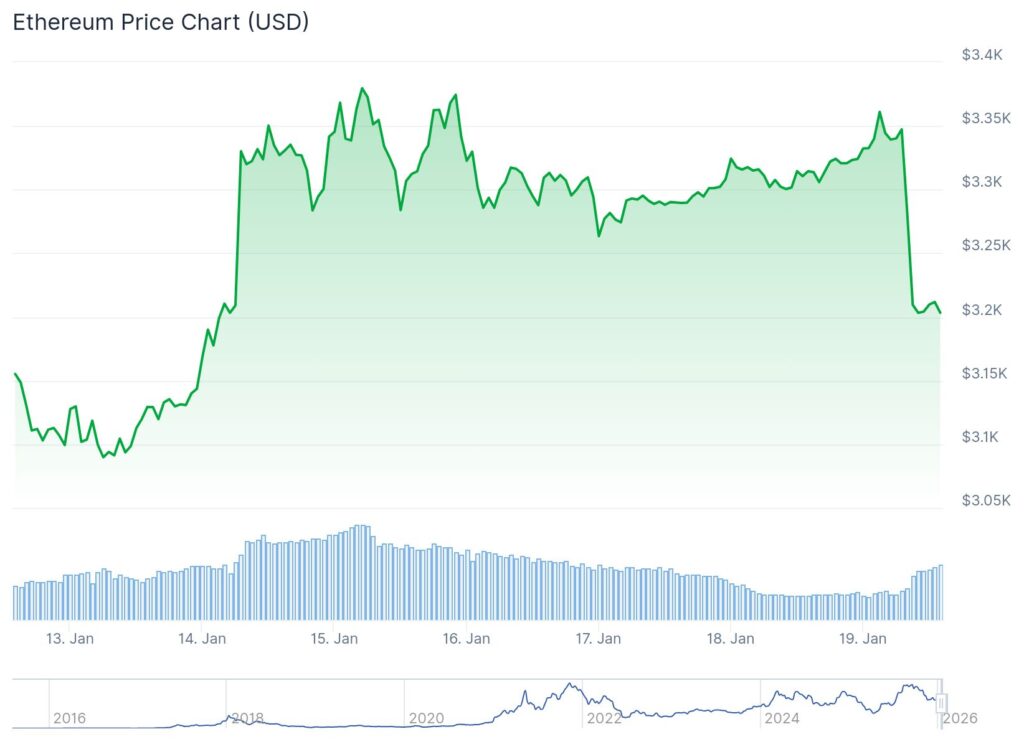
Ethereum entered January 18, 2026, trading within a relatively tight range even as broader cryptocurrency markets showed renewed signs of instability. While Bitcoin and several high-beta altcoins experienced sharper intraday swings, Ether managed to hold near recent levels, reinforcing perceptions of relative strength.
This resilience reflects Ethereum’s gradual transition from a speculative vehicle to foundational infrastructure within the digital asset ecosystem. Investors increasingly view Ether not only as a trade but as a long-term exposure to decentralized finance, tokenization, and blockchain-based settlement systems.
Network Usage Reaches New Local Highs
On-chain indicators reveal that Ethereum network usage climbed to a multi-week high during mid-January. Daily transaction counts rose steadily, accompanied by an increase in active addresses and smart-contract interactions.
Stablecoin transfers in particular surged, suggesting sustained demand for Ethereum as a settlement layer. Even as price action remained subdued, the underlying network continued processing significant economic activity, highlighting a divergence between market sentiment and real usage.
Layer-Two Growth Strengthens the Base Layer
A major contributor to rising activity has been the expansion of layer-two scaling networks. Rollups continue to process growing transaction volumes while periodically settling data back onto Ethereum’s main chain.
This architecture allows Ethereum to handle higher throughput without sacrificing decentralization or security. As rollups mature, they deepen reliance on the base layer, reinforcing Ethereum’s role as the settlement backbone for an expanding ecosystem of applications.
Recommended Article: Ethereum Trades Sideways as Network Fundamentals Offset Market Caution
ETF Flows Reflect Institutional Caution, Not Exit
Spot Ethereum exchange-traded funds have recorded mixed but generally modest flows in recent sessions. Some products saw minor outflows, while others remained flat, pointing to cautious portfolio adjustments rather than wholesale withdrawals.
Institutional investors appear to be managing exposure in response to macro uncertainty, including interest-rate expectations and geopolitical developments. The absence of sharp, sustained outflows suggests confidence in Ethereum’s long-term role remains intact.
Derivatives Markets Signal Balanced Positioning
Ethereum derivatives data reinforces the theme of moderation. Funding rates across major futures platforms remain close to neutral, indicating neither excessive optimism nor aggressive bearish positioning.
Options markets show similar balance, with traders hedging both upside and downside risks rather than concentrating bets in one direction. Historically, such conditions are associated with consolidation phases rather than imminent breakdowns or euphoric rallies.
Developer Activity Anchors Long-Term Confidence
Beyond market metrics, developer engagement remains a core pillar supporting Ethereum’s outlook. Work continues on improving data availability, validation efficiency, and overall network performance.
For enterprises and institutions assessing blockchain infrastructure, consistent technical progress matters as much as short-term price movements. Ethereum’s active developer community continues to signal long-term commitment to scalability and resilience.
Ethereum’s Role in a Shifting Crypto Landscape
Ethereum’s ability to sustain high network activity during periods of market uncertainty underscores its evolving identity. Unlike purely speculative assets, Ethereum increasingly derives value from usage rather than momentum alone.
As 2026 progresses, this dynamic may help buffer Ether during broader risk-off cycles. Price stability combined with rising on-chain demand suggests a market consolidating around fundamentals rather than retreating from them.
Outlook for Ethereum in Early 2026
Ethereum’s near-term trajectory remains tied to macro conditions and overall crypto sentiment. However, sustained network usage, balanced derivatives positioning, and steady institutional participation provide a supportive backdrop.
Rather than signaling weakness, current conditions point to a pause that allows the network to absorb growth. If activity trends continue, Ethereum may emerge from this consolidation with stronger foundations for the next phase of the market cycle.