

Bitcoin Breaks a Key Level but Avoids Panic Selling
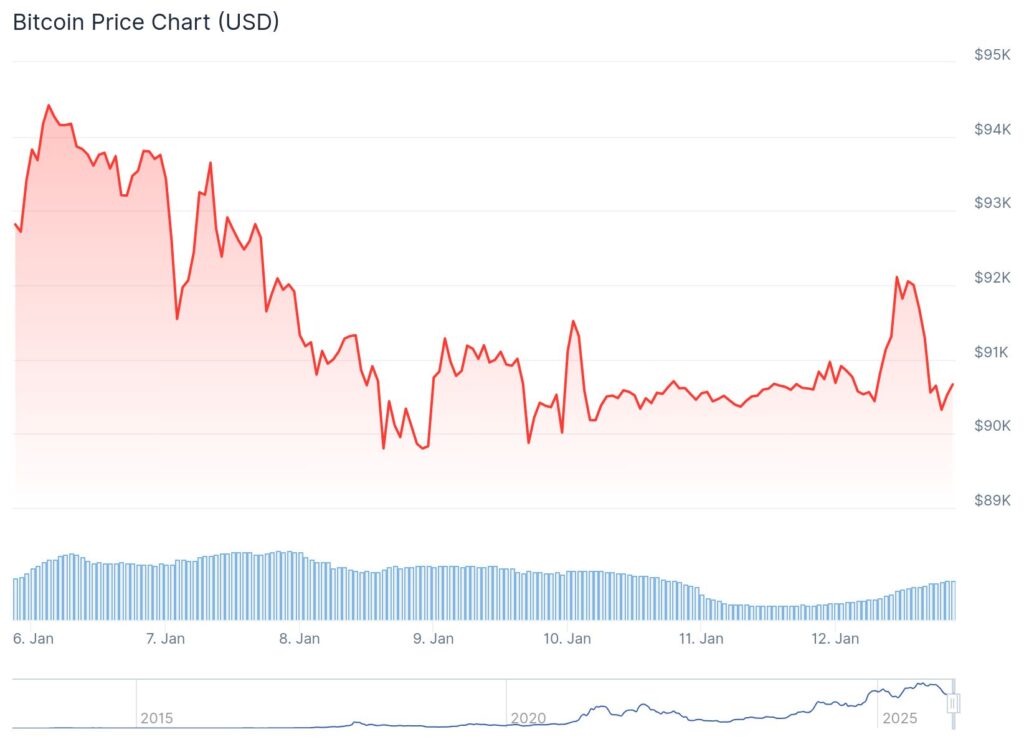
Bitcoin entered January 12, 2026, under renewed pressure after slipping below a closely watched technical support level. The move marked a shift in short-term momentum, unsettling traders who had expected the market to stabilize after recent consolidation. Prices declined modestly rather than collapsing, signaling that the break was driven more by caution than fear.
Despite the loss of support, market behavior remained orderly. Volatility increased briefly, but liquidity held up across major trading venues. This suggests the move reflects repositioning rather than a broad loss of confidence in Bitcoin’s longer-term outlook.
Short-Term Traders Reduce Risk Exposure
The immediate reaction to the price drop came from short-term traders and leveraged participants. Futures markets showed a decline in open interest, indicating that traders were closing positions rather than doubling down on directional bets. Funding rates normalized quickly, reinforcing the view that speculative excess was being cleared.
This reduction in leverage has helped limit downside acceleration. Historically, sharp Bitcoin sell-offs are often fueled by forced liquidations, but those dynamics have been largely absent so far in this pullback.
Long-Term Holders Remain Unmoved
On-chain data paints a contrasting picture to the short-term price action. Wallets associated with long-term holders show little increase in spending activity, suggesting that investors who accumulated Bitcoin years ago are not rushing to exit.
These holders tend to react more to structural shifts than daily price movements. Their continued inactivity implies that the recent decline is viewed as noise rather than a signal of deeper trouble. This behavior has historically provided a stabilizing force during periods of market uncertainty.
Recommended Article: Bitcoin Holds Firm Above $90,000 as Markets Reassess Risk in…
Macro Conditions Continue to Shape Sentiment
Broader macroeconomic factors remain a key influence on Bitcoin’s trajectory. Mixed economic data from the United States and Europe has complicated expectations around interest rate policy, keeping risk assets in a holding pattern.
Bitcoin’s sensitivity to real interest rates and liquidity conditions means traders are reluctant to commit aggressively in either direction. Until clearer signals emerge from central banks, price action is likely to remain reactive rather than trend-driven.
Institutional Flows Show Selective Caution
Institutional participation remains present but measured. Investment products tied to Bitcoin have seen uneven flows, with some days of modest inflows offset by periods of outflows. Importantly, there has been no evidence of mass institutional capitulation.
Many large investors appear to be maintaining core exposure while trimming tactical positions. This approach aligns with a broader strategy of risk management rather than a wholesale reassessment of Bitcoin’s role in portfolios.
Psychological Levels Still Dominate the Narrative
While the recent support break has drawn attention, larger psychological milestones continue to frame market expectations. The six-figure price level remains a focal point for both optimism and skepticism, shaping how traders interpret short-term moves.
As long as Bitcoin holds well above previous cycle highs, many participants view current weakness as part of a consolidation phase rather than the start of a prolonged downturn. This mindset has helped sustain bid interest on dips.
What Comes Next for Bitcoin in Early 2026
Bitcoin’s near-term outlook depends on whether the market can establish a new base above lower support zones. A period of sideways trading would allow sentiment to reset and reduce the risk of sharper declines.
If macro conditions stabilize and institutional flows turn more consistently positive, Bitcoin could regain momentum. For now, the resilience of long-term holders suggests that confidence in the asset’s broader thesis remains intact, even as short-term traders tread carefully.