


Bitcoin Slips to Nine-Month Low
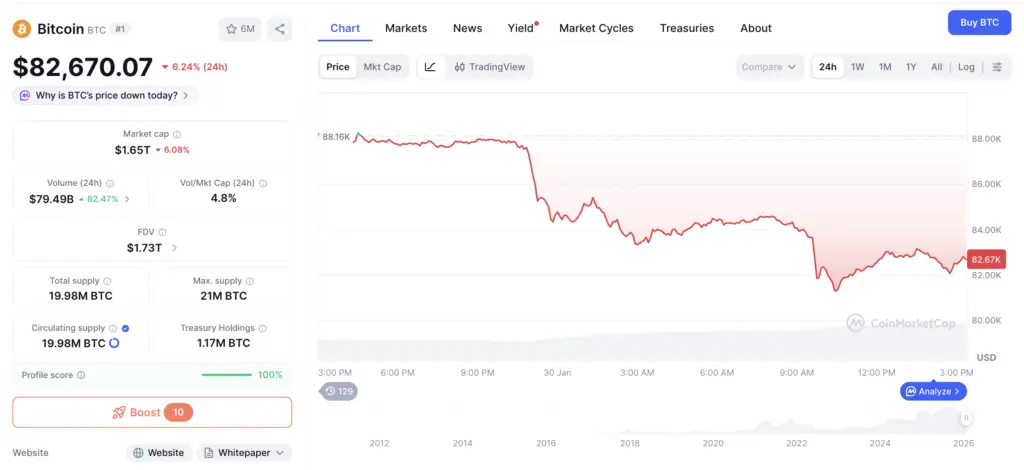
Bitcoin suffered a sharp sell-off, falling to roughly $82,000 and marking its lowest level in nine months. The decline erased a significant portion of the gains built up during last year’s rally, leaving the asset more than 35% below its October peak.
The move unfolded rapidly during early trading hours, catching many traders off guard. Market participants described the drop as disorderly, with selling pressure intensifying as key technical support levels failed to hold.
Liquidations Sweep Through Leveraged Positions
The price collapse triggered one of the largest liquidation events of the year. According to CoinGlass, approximately 270,000 traders were liquidated in a 24-hour period, wiping out around $1.7 billion in leveraged positions.
Long positions accounted for the overwhelming majority of losses, highlighting how crowded bullish bets had become. As forced selling accelerated, volatility spiked and liquidity thinned, deepening the downturn across major cryptocurrencies.
Coinbase Trading Highlights Market Stress
Bitcoin briefly touched its intraday low on Coinbase, underscoring stress in US-based trading venues. Data from TradingView showed that selling pressure intensified once prices breached widely watched support zones.
The broader crypto market followed Bitcoin lower, with total market capitalization shrinking by roughly $200 billion in a single day. Ether and other large-cap tokens experienced similar drawdowns as investors rushed to reduce exposure.
Recommended Article: Bitcoin Slides to Two-Month Low as ETF Outflows Deepen Market…
Middle East Tensions Shake Investor Confidence
Geopolitical risk played a central role in the sell-off. The United States dispatched additional naval assets to the Middle East amid rising tensions with Iran, reviving fears of military escalation.
Markets reacted nervously to the prospect of conflict disrupting global energy flows and financial stability. Risk assets across regions weakened as traders reassessed exposure in an increasingly uncertain geopolitical environment.
Donald Trump’s Tariff Threats Add Pressure
Further pressure came from renewed trade concerns after Donald Trump declared a national emergency and announced plans to impose tariffs on goods from countries supplying oil to Cuba. The move reignited fears of trade retaliation and broader economic disruption.
Tariff uncertainty has historically weighed on markets by increasing costs and clouding growth forecasts. In crypto markets, where sentiment shifts quickly, the announcement contributed to a rapid de-risking wave.
Tech Stocks and AI Fears Spill Into Crypto
Weakness in technology stocks amplified the crypto sell-off. Shares of Microsoft fell sharply following disappointing earnings, raising concerns about slowing growth in AI-related investments.
According to comments from executives at BTSE, investors worried that a broader pullback in AI-driven equities could spill into digital assets. As portfolios were rebalanced, cryptocurrencies were among the first assets to be trimmed.
Gold Fails to Offer Immediate Refuge
Even traditional safe havens struggled during the market turmoil. Gold prices retreated sharply from recent highs, while silver experienced an even steeper correction. The simultaneous sell-off across asset classes highlighted the scale of deleveraging underway.
For Bitcoin, comparisons with gold resurfaced once again. Critics pointed to the divergence as evidence that Bitcoin remains a risk asset, while supporters argued that short-term correlations do not negate long-term scarcity fundamentals.
Key Support Levels Now in Focus
With Bitcoin hovering near critical monthly support zones, traders are closely watching whether prices stabilize or extend lower. A sustained break below current levels could trigger further liquidations, while consolidation may help restore confidence.
Despite the severity of the sell-off, some investors argue that much of the downside has already been priced in. They note that Bitcoin had been trending lower for months, making the liquidation cascade more a release of excess leverage than a fundamental shift.
What Comes Next for Bitcoin Markets
Bitcoin’s near-term trajectory will depend on geopolitical developments, trade policy signals, and broader risk sentiment. Any easing of tensions in the Middle East or clarification around tariffs could help calm markets.
For now, the episode serves as a reminder of crypto’s vulnerability to macro shocks. As Bitcoin becomes increasingly intertwined with global markets, price swings are likely to reflect not just internal dynamics, but the full weight of geopolitical and economic uncertainty.