Bitcoin Finds Support After Overnight Volatility
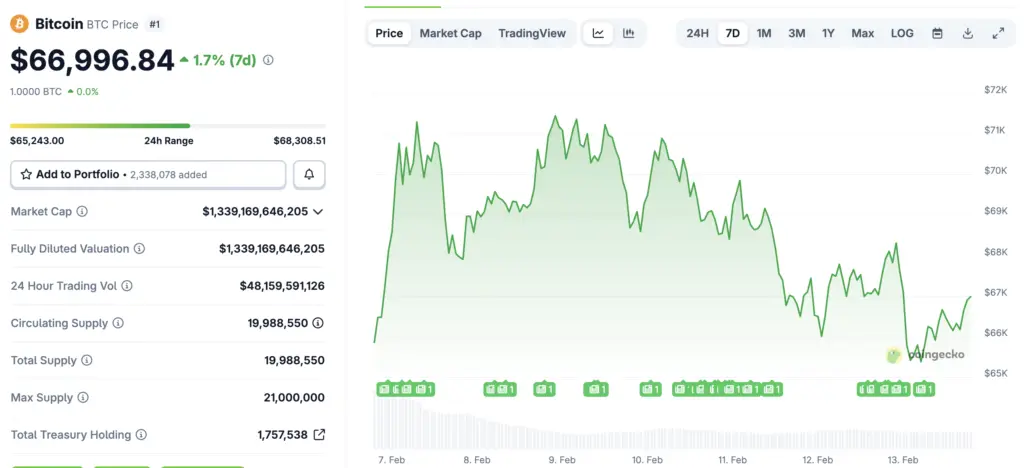
Bitcoin stabilized during Asian trading hours after experiencing notable turbulence in the United States, where prices briefly dropped to their lowest level of the week. The rebound suggests that buyers are still willing to step in at key psychological levels, preventing a deeper sell-off despite fragile sentiment across financial markets.
Market participants increasingly view Bitcoin as a macro-sensitive asset rather than a purely speculative instrument. As a result, movements in equities, bond yields, and currency markets now exert stronger influence over crypto pricing, reinforcing the idea that digital assets are becoming embedded within the broader financial ecosystem.
Standard Chartered Warning Shapes Investor Behavior
A recent note from Standard Chartered warned that Bitcoin could face additional weakness if global liquidity continues to tighten. The bank pointed to persistent inflation risks and the possibility of higher-for-longer interest rates as factors that could limit capital flows into volatile assets.
Institutional commentary often carries outsized influence because large asset managers use these signals to guide allocation strategies. When major banks adopt a cautious tone, hedge funds and professional investors frequently respond by trimming exposure, which can dampen bullish momentum even without a major negative catalyst.
Institutional Traders Adopt Defensive Positioning
Large investors appear to be shifting toward capital preservation rather than aggressive accumulation. Trading desks report reduced leverage and smaller directional bets, reflecting a broader effort to manage downside risk while macro uncertainty remains unresolved.
This defensive posture does not necessarily imply bearish conviction. Instead, it signals that institutions are waiting for clearer economic signals before committing meaningful capital, a pattern commonly observed during transitional market phases.
Recommended Article: Bitcoin Braces for CPI as Fed Rate Cut Hopes Fade
Macro Forces Continue to Drive Crypto Correlations
Bitcoin’s growing correlation with traditional markets underscores how much the asset class has matured. Rising real yields, shifting expectations around central bank policy, and geopolitical tensions are now key variables shaping daily price action.
Such dynamics mark a departure from earlier crypto cycles that were largely driven by internal industry developments. Today, macro narratives often overshadow blockchain-specific news, forcing traders to monitor economic indicators as closely as on-chain metrics.
Ether Stabilizes but Lacks Independent Momentum
Ether mirrored Bitcoin’s recovery, hovering near recent support levels after dipping earlier in the week. The synchronized movement highlights the extent to which major cryptocurrencies trade as a unified risk basket rather than independent assets.
While Ethereum’s technological roadmap continues to attract long-term interest, short-term price behavior suggests that macro forces remain the dominant driver. Until liquidity conditions improve, analysts expect altcoins to remain highly sensitive to Bitcoin’s direction.
Liquidity Conditions Become the Market’s North Star
Access to liquidity remains one of the most critical determinants of crypto performance. When financial conditions tighten, speculative markets often struggle because investors prioritize safer assets with predictable returns.
Conversely, periods of expanding liquidity historically coincide with powerful crypto rallies. This relationship explains why traders are closely monitoring signals from the Federal Reserve, whose policy trajectory could ultimately dictate the next major market move.
Outlook Hinges on Confidence Returning to Risk Assets
Looking ahead, Bitcoin’s near-term trajectory will likely depend on whether confidence returns to global risk markets. Strong economic data could paradoxically pressure crypto if it reinforces expectations for restrictive monetary policy.
For now, the asset appears trapped between resilient long-term adoption trends and short-term macro headwinds. Whether Bitcoin breaks higher or revisits recent lows may depend less on crypto-specific developments and more on the evolving direction of the global economy.