

WASHINGTON — December 9, 2025 — President Donald Trump has given Nvidia and other US chipmakers approval to sell their advanced H200 artificial intelligence processors to “approved customers” in China, marking a major policy shift that could reshape global semiconductor dynamics. The move follows intense lobbying from Nvidia CEO Jensen Huang and comes despite mounting concerns from US security officials about China’s access to cutting-edge AI hardware.
Trump announced the decision on social media, framing it as a compromise that strengthens national security while protecting American jobs and technological leadership. The policy reverses previous restrictions that barred Nvidia from selling its most powerful AI chips to China, a key market for the company.
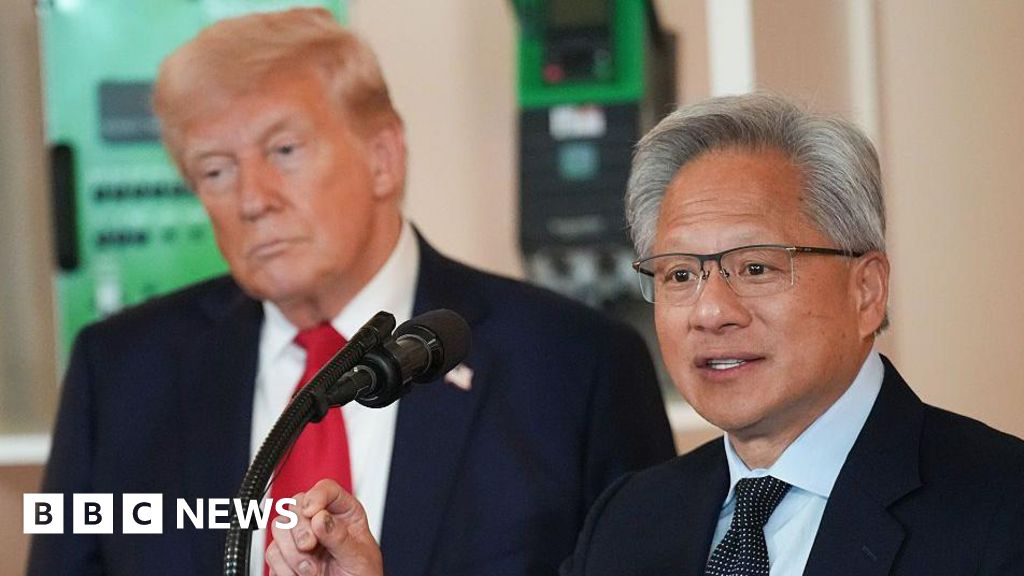
Nvidia Secures Breakthrough After Months of Lobbying
The approval represents a significant victory for Nvidia, the world’s most valuable semiconductor firm, which has been caught in the middle of a high-stakes technological standoff between Washington and Beijing. Jensen Huang visited Washington last week to rally support for loosening export rules, arguing that the US chip industry needed access to global markets to sustain innovation and manufacturing capacity.
Nvidia praised the decision, calling it a “thoughtful balance” that supports American workers while allowing US companies to compete internationally. The company emphasized that the Commerce Department will vet all Chinese customers and that the H200 chip, while powerful, is still one generation behind Nvidia’s state-of-the-art Blackwell line.
China Responds as US Policy Signals Strategic Flexibility
Beijing has not formally commented, but Chinese tech firms had already been instructed to stop purchasing Nvidia’s previous H20 model, prompting a push toward domestically produced semiconductors. Analysts say the new policy offers China temporary relief but is unlikely to alter its long-term strategy of reducing reliance on US technology.
Experts note that China maintains near-total dominance in the global processing of rare earth minerals essential to electronics manufacturing. Allowing limited access to Nvidia’s chips may “buy time” for Washington to negotiate more stable terms in supply chain talks with Beijing.
Recommended Article: Trump Approves Nvidia Sales of Advanced AI Chips to China…
National Security Hawks Raise Red Flags Over AI Military Risks
While Nvidia celebrated the decision, national security analysts warned that advanced AI chips could accelerate China’s military applications. Researchers at Georgetown University’s Center for Security and Emerging Technology have documented the use of US-designed chips in China’s development of AI-enabled weapons and surveillance systems.
“Easier access to high-quality AI chips enables China to advance military AI systems faster,” said Cole McFaul, a senior analyst at CSET. Critics argue that even one-generation-old processors like the H200 still provide powerful computational capabilities sought by China’s defense sector.
Congressional hawks are expected to challenge the decision, and Trump’s own announcement — which incorrectly stated that “$25% will be paid to the United States of America” — has generated questions about how revenue-sharing requirements will be enforced.
US Companies Gain Market Access as Chip Policy Evolves
The decision also applies to AMD and other American semiconductor firms, expanding the commercial impact beyond Nvidia alone. Analysts say the move reflects growing pressure on the administration to preserve US leadership in AI while balancing geopolitical risks.
Huang has repeatedly warned that China is only “one to two years behind” the US in chip development and that cutting off access entirely could hasten China’s self-sufficiency. The administration’s new policy appears to acknowledge this, opting for controlled engagement rather than full decoupling.
Global Supply Chains Hang in the Balance
Researchers and industry analysts say the approval could help stabilize strained supply chains, especially in sectors dependent on AI-training hardware. The move also allows Washington to build leverage in negotiations over rare earth minerals — an area where the US remains heavily dependent on Chinese processing infrastructure.
If China accelerates efforts to replace American chips with homegrown alternatives, the market could shift even more dramatically. Beijing has already urged tech firms to reject Nvidia’s older H20 models and buy domestically produced processors.
AI Competition Escalates as Both Nations Pursue Strategic Advantage
Trump’s decision underscores the growing geopolitical complexity around AI chips — now considered strategic assets on par with energy and defense technologies. While the H200 sale provides near-term economic relief for US manufacturers, it also introduces new security questions and intensifies the race for AI dominance.
For Nvidia, the approval marks a significant win. For Washington and Beijing, it signals that competition in AI hardware is accelerating — and that both sides are recalibrating their strategies in real time.