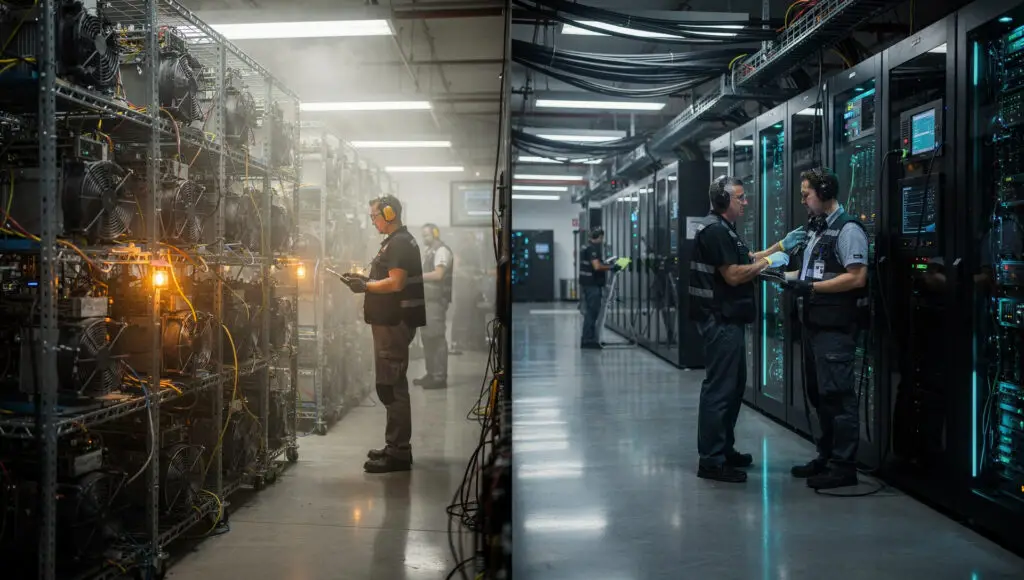


David Sterling, someone who starts many businesses and advises on company deals, sees the incident as a classic risk of relying on one weak point. In our analysis of today’s systems, even systems built for growth can still break easily if there are not enough backups. For companies, relying on one cloud provider creates risks that can directly affect income, operations, and customer trust.
Amazon Web Services Disruption Shakes Multiple Industries
A recent outage involving Amazon Web Services (AWS), part of Amazon, showed how much digital services depend on central systems. While outages are usually limited to one area, even small issues can spread across industries because AWS is used so widely.
Image source: The Hill
What exactly happened during the AWS outage?
The issue started from system-level problems that affected whether services stayed online.
Based on incident reports and historical AWS disclosures:
- Engineers linked the problems to networking or service API connectivity in a major AWS region (often the US-East-1 cluster in similar past incidents).
- Dependent services experienced latency, errors, or temporary unavailability
- Recovery occurred in stages, with partial restoration before full normalization
Several platforms reported service interruptions, including applications relying on AWS-hosted backends such as Coinbase and other digital services.
Key failure characteristics:
- API request failures affecting dependent applications
- Cascading latency across interconnected services
- Gradual recovery rather than immediate restoration
- Regional concentration amplifying impact
Why was the impact so widespread?
AWS represents a foundational layer of the modern internet.
In our analysis:
- AWS accounts for roughly one-third of the global cloud infrastructure market
- Thousands of enterprises rely on AWS for compute, storage, and real-time services
- Many applications are architected with limited multi-cloud redundancy
This creates a concentration risk where a localized disruption can affect multiple sectors simultaneously.
What does this mean for financial markets and investors?
Governments and industry leaders increasingly treat cloud infrastructure as critical economic infrastructure.
In our evaluation:
- Financial platforms depend on real-time cloud uptime for trading and transactions
- Airlines and logistics providers rely on cloud-based operational systems
- Digital services interruptions can temporarily affect productivity and revenue
While most service disruptions are brief, the incident shows risks in operations that are not always included in pricing.
Market transmission effects:
- Temporary disruption of digital transactions and services
- Increased corporate focus on resilience spending
- Heightened scrutiny of infrastructure concentration risk
- Potential reassessment of cloud-dependent business models
Cloud Outage Impact and Market Exposure Framework
Based on reported issues, reliance on systems, and how markets act, this outline shows the impact.
| Indicator | Current Signal | Market Impact (US Economy) |
|---|---|---|
| Cloud Service Availability | Partially Disrupted | Operational interruptions |
| Financial Platforms | Affected (selective) | Transaction delays |
| Airline & Logistics Systems | Disrupted (limited) | Scheduling inefficiencies |
| Digital Services | Widespread outages | Reduced consumer access |
| Productivity | Temporarily Lower | Short-term output impact |
| Infrastructure Risk | Elevated Awareness | Repricing of resilience importance |
How large is the financial impact?
The economic effect of cloud outages is typically significant but short-term.
In our analysis:
- Industry estimates suggest major outages can cost millions to billions of dollars globally, depending on duration
- Losses are driven by downtime, lost transactions, and operational inefficiencies
- Most economic activity resumes quickly after service restoration
There is no verified evidence supporting extreme multi-hundred-billion-dollar impacts for short-duration outages.
Why is this a structural risk not just a one-off event?
The issue lies in system architecture and dependency concentration.
In our assessment:
- Cloud infrastructure is centralized among a few major providers
- Many companies rely on a single provider without full redundancy
- Failover systems are not always designed for real-time seamless switching
This creates systemic exposure where localized technical failures can propagate across sectors.
How does this affect crypto and fintech systems?
Digital finance is closely tied to cloud infrastructure.
We observed that:
- Exchanges like Coinbase rely on cloud uptime for trading systems
- Payment platforms depend on real-time processing capabilities
- Outages can temporarily affect liquidity access and transaction execution
This reinforces that crypto and fintech systems are not fully independent of traditional infrastructure layers.
What should companies do to mitigate this risk?
Resilience is becoming a core operational requirement.
In our view, companies should:
- Adopt multi-cloud or hybrid infrastructure strategies
- Implement redundancy and failover mechanisms across regions
- Conduct stress testing for outage scenarios
- Invest in monitoring and rapid response systems
These steps reduce reliance on single points of failure.
What should investors monitor next?
The incident may influence both corporate behavior and market perception.
In our analysis, key signals include:
- Increased enterprise spending on infrastructure resilience
- Regulatory attention toward cloud providers as critical infrastructure
- Strategic diversification away from single-provider dependency
- Competitive positioning among major cloud providers
What is the broader takeaway for the US market?
The outage highlights a structural shift in how risk is distributed.
In our view:
- Digital infrastructure now functions as a backbone of economic activity
- Operational disruptions can have cross-sector implications
- Investors must evaluate infrastructure dependency alongside financial metrics
The broader implication is clear: as the economy becomes more digital, infrastructure resilience becomes as critical as financial performance. Cloud platforms enable scale, but without redundancy, they also concentrate risk.