Elena Chen, a blockchain developer and DeFi security auditor specializing in on-chain liquidity and financial infrastructure, views current market divergence through the lens of capital mobility. In our analysis of decentralized systems, periods of geopolitical uncertainty often trigger reallocations toward permissionless financial networks. This behavior reinforces crypto’s emerging role as a parallel liquidity layer, particularly when traditional markets reprice geopolitical risks.
Oil Prices Reflect Geopolitical Risk While Crypto Remains Calm
Recent geopolitical developments involving Venezuela, alongside evolving U.S. foreign policy signals, have contributed to an unusual market pattern. According to energy market data and crypto market trackers, oil prices have shown sensitivity to supply expectations, while digital assets such as Bitcoin and Ethereum have remained relatively stable during the same period.
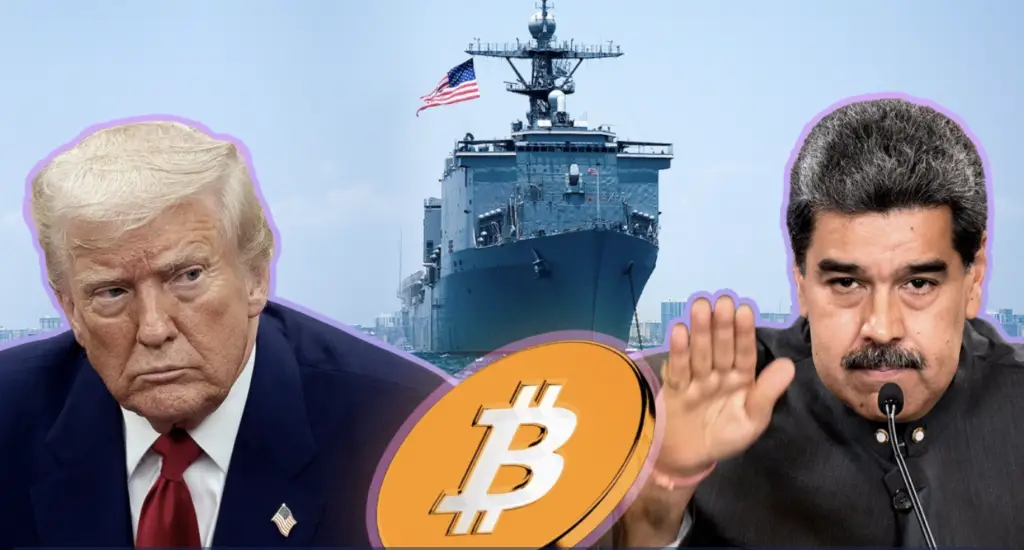
Image source: DL News
Why are oil prices reacting differently to geopolitical tension?
Oil market behavior is currently being shaped more by supply expectations than by disruption fears.
In our analysis of data from institutions such as the International Energy Agency and the U.S. Energy Information Administration:
- Markets are factoring in the possibility of increased Venezuelan oil output under evolving policy conditions
- Supply-side expectations are offsetting traditional geopolitical risk premiums
- Traders are pricing potential changes in sanctions or export flows
This has led to periods where oil prices respond more to anticipated supply increases than to escalation headlines.
Key drivers of oil price movement:
- Expectations of expanded Venezuelan production capacity
- Shifts in U.S. policy toward energy exports and sanctions
- Market focus on supply availability rather than disruption risk
Why has crypto remained relatively stable?
Digital asset markets have shown resilience during the same period.
Based on aggregated market data from platforms such as CoinMarketCap and on-chain analytics providers like Glassnode:
- Bitcoin and Ethereum price movements have remained within relatively stable ranges compared to traditional commodities
- Total crypto market capitalization has shown resilience despite geopolitical developments
- On-chain activity suggests continued liquidity participation rather than large-scale risk-off behavior
This reflects crypto’s evolving role not purely as a speculative asset, but as an alternative liquidity network.
Observed crypto market behavior:
- Stable price ranges during geopolitical headlines
- Continued network activity and transaction volume
- Limited correlation with short-term oil price volatility
How does this affect investors and asset allocation?
Markets are increasingly showing divergence across asset classes.
In our analysis of multi-asset behavior:
- Energy markets are responding to supply expectations rather than geopolitical escalation alone
- Crypto assets are acting as alternative channels for capital allocation
- Traditional hedging relationships are becoming less consistent
This creates a more complex environment for portfolio construction.
Market transmission effects:
- Oil price volatility linked to supply-side narratives
- Increased attention on crypto as a non-traditional asset class
- Repricing of energy-related equities
- Greater need for diversified portfolio strategies
Asset Reaction to Geopolitical Developments Framework
Based on energy market data, blockchain analytics, and cross-asset observations, the following framework summarizes current dynamics.
| Indicator | Current Signal | Market Impact (Global Assets) |
|---|---|---|
| Oil Prices (WTI) | Volatile / Moderating | Supply-driven repricing |
| Energy Sector Equities | Mixed | Linked to production expectations |
| Bitcoin Price Stability | Relatively stable | Alternative asset positioning |
| Crypto Market Activity | Sustained | Continued liquidity participation |
| Geopolitical Risk Pricing | Diverging | Uneven asset responses |
| Capital Allocation Trends | Shifting | Increased diversification |
How has crypto functioned in Venezuela’s economy?
Crypto adoption in Venezuela has been driven by practical economic needs.
According to research from Chainalysis and regional studies:
- Digital assets have been used to facilitate cross-border payments amid financial restrictions
- Stablecoins have supported everyday transactions during periods of currency instability
- Crypto has served as a store of value in response to inflation and currency depreciation
This positions blockchain networks as functional financial rails in constrained environments.
Key use cases:
- Cross-border transfers outside traditional banking systems
- Value preservation during currency volatility
- Settlement mechanisms for informal and digital economies
Could geopolitical developments increase crypto scrutiny?
Yes, particularly from regulators and policymakers.
In our assessment:
- Governments are increasingly monitoring crypto transactions for compliance and sanctions enforcement
- Blockchain analytics firms are tracking transaction flows more closely
- Regulatory frameworks are evolving to address cross-border digital asset usage
This creates a dual dynamic: rising adoption alongside increasing oversight.
What signals should investors watch next?
Market behavior remains data-driven and dynamic.
Key indicators include:
- Oil supply forecasts from the International Energy Agency
- On-chain metrics such as transaction volume and wallet activity
- Stablecoin demand and liquidity trends
- Policy developments affecting energy markets and digital assets
These signals help determine how capital flows adjust during geopolitical uncertainty.
How does this reshape the role of crypto in global finance?
The current environment highlights crypto’s evolving role.
In our view:
- It serves as a complementary liquidity layer alongside traditional markets
- It provides alternative access to financial systems under constraints
- It introduces new dynamics in how capital responds to global events
This positions crypto as both an innovation in financial infrastructure and a growing area of regulatory focus.
What should investors take away from this divergence?
The key lesson is not replacement but coexistence.
In our analysis, investors should:
- Recognize that different asset classes respond differently to the same geopolitical signals
- Monitor both traditional and digital markets in parallel
- Incorporate diversified exposure across multiple asset categories
The broader takeaway is structural: global markets are entering a phase where energy, geopolitics, and digital assets interact in increasingly complex ways, requiring more adaptive and data-informed investment strategies.