Ethereum Price Stabilizes After Early-Year Volatility
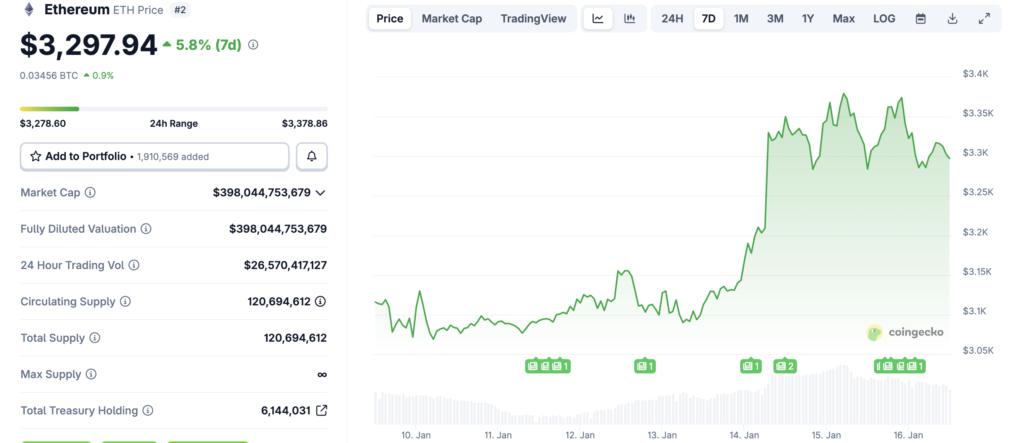
Ethereum entered mid-January 2026 trading within a relatively narrow range after a volatile start to the year. Prices have hovered near recent support levels, reflecting a market that has paused rather than reversed. This sideways movement suggests traders are reassessing risk following sharp fluctuations driven by macro headlines and shifting sentiment across digital assets.
Unlike periods of abrupt sell-offs, Ethereum’s current consolidation shows little evidence of panic. Instead, price action points to equilibrium between buyers seeking long-term exposure and sellers locking in gains after previous rallies. This balance has kept Ethereum anchored despite broader uncertainty in global markets.
Network Activity Provides Structural Support
Underlying network data continues to strengthen Ethereum’s long-term case. Transaction volumes remain elevated, and activity across decentralized finance, stablecoin transfers, and layer-two networks has shown resilience. These trends indicate that Ethereum’s role as a foundational settlement layer continues to expand, independent of short-term price movements.
Layer-two solutions, in particular, have absorbed a growing share of transactions, reducing congestion and improving cost efficiency. This shift supports scalability while reinforcing Ethereum’s broader ecosystem advantage. For many investors, consistent network usage serves as a stabilizing force during periods of market indecision.
Institutional Interest Remains Selective
Institutional engagement with Ethereum has become more nuanced in 2026. Rather than aggressive accumulation, many large investors are taking a measured approach, balancing exposure across multiple digital assets. Spot Ethereum investment products have seen uneven flows, reflecting rotation rather than wholesale withdrawal.
This selectivity mirrors broader institutional behavior across risk assets. Portfolio managers are increasingly sensitive to macro signals, liquidity conditions, and regulatory developments. As a result, Ethereum’s institutional demand has become steadier but less explosive than in earlier growth phases.
Recommended Article: Ethereum DeFi Growth Outpaces Price Action Amid Market Caution
Derivatives Markets Signal Controlled Risk
Ethereum derivatives markets suggest that traders are managing risk cautiously. Open interest remains high, indicating active participation, but funding rates have largely normalized. This implies that leverage is present but not excessively skewed toward one direction.
Options markets show a preference for strategies that hedge volatility rather than chase immediate upside. This positioning reduces the probability of sharp liquidation-driven moves while leaving room for gradual price appreciation if sentiment improves. Overall, derivatives data points to restraint rather than speculation.
Competition Highlights Ethereum’s Trade-Offs
Ethereum continues to face competition from alternative blockchains offering lower fees and faster execution. These networks have attracted specific use cases and developer communities, intensifying the battle for users and capital. However, Ethereum’s depth, security, and composability remain difficult to replicate at scale.
Rather than eroding Ethereum’s dominance outright, competition has pushed the ecosystem toward specialization. Ethereum increasingly positions itself as a secure base layer, with activity migrating to secondary networks for efficiency. This layered approach reflects maturity rather than decline.
Upgrades Shape Long-Term Expectations
Ethereum’s ongoing upgrade path remains a key driver of investor confidence. Improvements focused on data availability, validation efficiency, and scalability are gradually reshaping how the network operates. While these upgrades do not produce immediate price reactions, they influence long-term valuation models.
Developers and institutions alike view Ethereum’s roadmap as incremental but reliable. The emphasis on sustainability and decentralization reinforces trust, even as rapid innovation elsewhere captures headlines. For long-term participants, execution consistency matters more than short-term hype.
Ethereum’s Outlook for Early 2026
Ethereum’s near-term outlook appears defined by patience rather than momentum. Without a strong macro catalyst or surge in capital inflows, consolidation may persist. However, the absence of significant downside pressure suggests that confidence in Ethereum’s fundamentals remains intact.
As 2026 unfolds, Ethereum’s trajectory will depend on whether network growth translates into renewed investor enthusiasm. For now, stability reflects a market that is neither euphoric nor fearful—an environment that often precedes the next decisive move.