


Bitcoin’s Market Response to Inflation Data
As a blockchain developer and DeFi security auditor, Elena Chen evaluates crypto markets through a code-first lens that focuses on liquidity flows, execution logic, and systemic risk.
In our analysis of the current market, Bitcoin’s reaction to inflation data reflects a structural transition. Crypto is no longer trading in isolation. It is increasingly embedded within the global liquidity cycle.
This perspective aligns on-chain activity with macro signals, where capital flows into blockchain networks respond directly to monetary conditions.
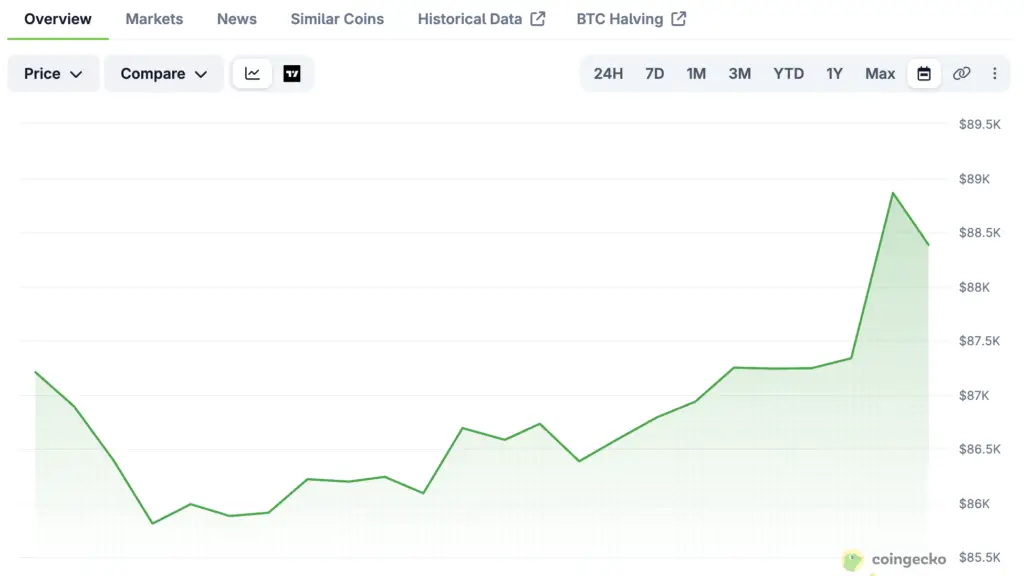
Why did Bitcoin rise after the inflation report?
The trigger was macroeconomic rather than crypto-specific.
According to the latest data from the U.S. Bureau of Labor Statistics, headline CPI came in at approximately 3.2 percent year over year, below expectations near 3.4 percent.
We observed that:
- Lower-than-expected inflation shifted expectations toward earlier rate cuts
- Risk assets responded positively across equities and crypto markets
- Bitcoin rebounded toward the $88,000 to $90,000 range after prior weakness
This confirms that Bitcoin is reacting to the same macro catalysts that drive traditional financial markets.
What does inflation have to do with crypto prices?
The relationship is rooted in liquidity transmission.
In our evaluation:
- Lower inflation increases the probability of monetary easing
- Monetary easing expands liquidity across financial systems
- Increased liquidity supports higher valuations for risk-sensitive assets
According to policy signals from the Federal Reserve, markets are increasingly forward-looking, pricing rate cuts based on incoming inflation data rather than waiting for official policy changes.
This positions Bitcoin alongside equities, particularly growth and technology stocks, as a macro-sensitive asset.
How did interest rate expectations shift after the CPI release?
Market pricing adjusted rapidly following the data.
We observed that:
- Futures markets increased the probability of rate cuts within the next policy cycles
- The US 10-year Treasury yield declined modestly, reflecting easing expectations
- Liquidity-sensitive assets, including crypto, experienced immediate inflows
This illustrates how expectations about monetary policy, rather than actual rate changes, drive short-term price movements.
Why did Bitcoin fall before the rebound?
Market positioning ahead of the data played a key role.
We observed that:
- Early estimates suggested inflation could remain elevated
- Investors positioned defensively, reducing exposure to risk assets
- Bitcoin declined toward the $85,000 range before the official data release
This highlights a key principle in financial markets. Expectations are often priced in before actual data confirms or contradicts them.
What does this say about crypto market maturity?
The market is evolving toward macro integration.
In our assessment:
- Price action is increasingly driven by economic data rather than narratives
- Institutional participation is shaping market structure
- Macro variables such as inflation and interest rates are becoming dominant drivers
This indicates that crypto is transitioning into a recognized component of the global financial system.
Are crypto and traditional markets now fully connected?
The connection is strengthening, but not absolute.
We observed that:
- Bitcoin shows increasing correlation with equity indices during macro events
- Volatility remains higher than traditional asset classes
- Crypto-specific factors such as regulation and adoption still influence price behavior
This creates a hybrid asset profile. Bitcoin behaves partly as a macro asset and partly as an emerging technology investment.
How are investors reacting to macro-driven crypto moves?
The response is increasingly global and institutional.
In our analysis:
- Investors are aligning crypto exposure with macroeconomic indicators
- Capital flows are reacting to US monetary policy signals
- Portfolio strategies now treat Bitcoin as part of a broader risk asset allocation
This reinforces Bitcoin’s role as a global liquidity barometer.
Inflation Data and Crypto Market Reaction
| Metric | Current Value | Market Interpretation |
|---|---|---|
| CPI YoY | ~3.2 percent | Lower inflation supports risk assets |
| Expected CPI | ~3.4 percent | Positive surprise drives sentiment |
| 10 Year Treasury Yield | Declining trend | Signals easing liquidity conditions |
| Bitcoin Price | ~$88,000 to $90,000 | Strong rebound after data |
| Rate Cut Expectations | Increasing | Supports liquidity expansion |
| Market Correlation | Rising | Stronger linkage with equities |
What risks should investors consider in this macro-driven environment?
Even positive macro signals do not eliminate risk.
Key considerations:
- Inflation could reaccelerate, delaying rate cuts
- Central banks may maintain restrictive policy longer than expected
- Crypto markets remain highly sensitive to rapid sentiment shifts
- Regulatory developments could introduce volatility independent of macro trends
Institutions such as the International Monetary Fund have noted that rapid shifts in global liquidity conditions can amplify volatility across emerging asset classes, including crypto.
What should investors watch next?
The next phase will be driven by macro confirmation.
In our analysis, key indicators include:
- Upcoming inflation reports and trend consistency
- Policy guidance from the Federal Reserve
- Movements in bond yields and liquidity conditions
- Institutional inflows into crypto markets
These signals will determine whether the rebound evolves into a sustained trend.
How should investors interpret this rebound?
The move reflects improving conditions, but not certainty.
In our view:
- Short-term gains are driven by repricing of macro expectations
- Long-term direction depends on sustained liquidity expansion
- Volatility will remain elevated as markets react to incoming data
The broader takeaway is clear. Bitcoin is now deeply integrated into the global financial system, responding to the same forces that drive equities, bonds, and currencies.