Bitcoin Diverges From Global Money Supply Trends
Bitcoin has significantly underperformed compared to global M2 money supply growth over recent months. While liquidity expanded by around twelve percent, Bitcoin declined roughly thirty-five percent during the same timeframe.
This divergence has created one of the largest historical gaps between liquidity indicators and Bitcoin market valuation. Analysts believe such gaps are typically temporary and often resolve through strong price recoveries over time.
Analysts Suggest Higher Fair Value for Bitcoin
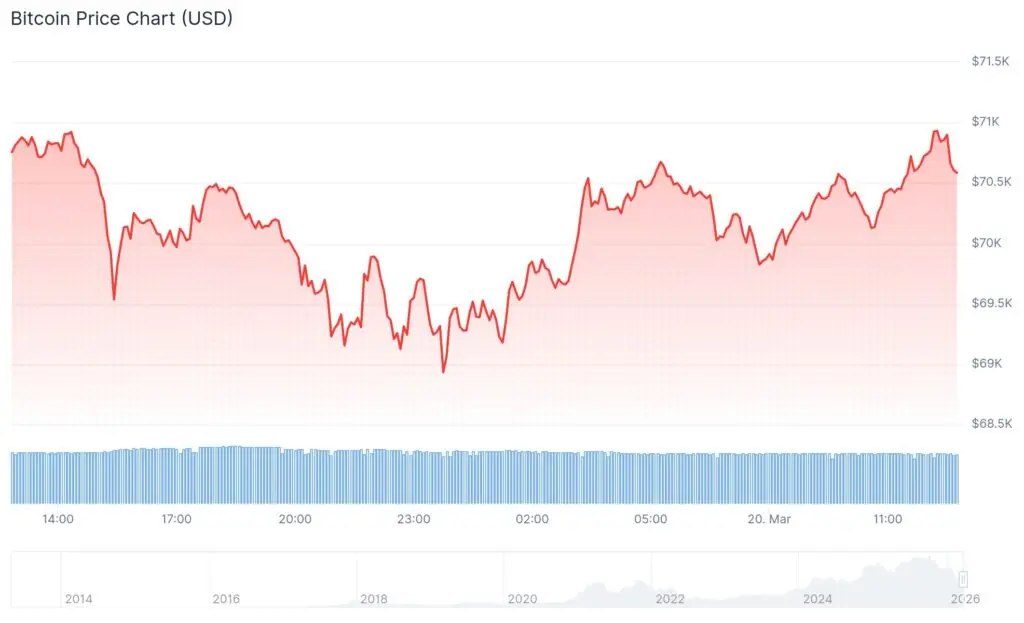
A model from CF Benchmarks estimates Bitcoin’s fair value near one hundred thirty-six thousand dollars currently. This valuation stands in sharp contrast to its present trading level around seventy thousand dollars in markets.
Such projections are based on historical correlations between liquidity growth and Bitcoin price performance trends. If conditions normalize, Bitcoin could experience substantial upside as markets realign with macroeconomic fundamentals.
Tight Monetary Policy Limits Capital Flows
Despite global liquidity expansion, U.S. monetary policy remains restrictive, limiting risk asset inflows including cryptocurrencies. The Federal Reserve continues maintaining elevated interest rates while reducing its balance sheet significantly since 2022.
This tightening reduces available capital for speculative investments, making it harder for Bitcoin to rally strongly. As a result, Bitcoin currently follows broader financial conditions rather than pure liquidity expansion signals.
Rising Energy Costs Strain Consumer Liquidity
Increasing fuel prices are putting additional pressure on household finances across major economies, especially the United States. Gasoline price increases could cost households hundreds of dollars annually, reducing disposable income for investments.
Even tax refunds may not fully offset these rising costs, limiting funds available for equities and crypto assets. This shift weakens retail participation, which has historically played a key role in Bitcoin price growth cycles.
Geopolitical Risks Add Inflationary Pressure
Ongoing tensions in the Middle East have disrupted oil markets, pushing prices toward one hundred dollars per barrel. These developments increase inflation risks and complicate central bank decisions regarding interest rate adjustments.
Higher energy prices and geopolitical uncertainty create unfavorable conditions for risk assets like cryptocurrencies. Investors often become cautious during such periods, reducing exposure to volatile markets including Bitcoin.
ETF Demand Shows Strong Structural Support
Despite macro pressures, Bitcoin continues attracting institutional demand through exchange-traded funds in recent weeks. Spot Bitcoin ETFs recorded over one billion dollars in inflows before experiencing a short-term reversal.
This steady institutional participation represents a new structural support compared to previous market cycles historically. Analysts believe sustained ETF demand could provide a strong foundation for future Bitcoin price appreciation.
Future Outlook Depends on Policy Shifts
Bitcoin’s trajectory will likely depend on changes in monetary policy and easing financial conditions globally. Rate cuts or slower balance sheet reductions could unlock liquidity and drive capital back into risk assets.
If geopolitical tensions stabilize and energy prices decline, market sentiment may improve significantly across sectors. Under such conditions, Bitcoin could eventually align with liquidity trends and close the current valuation gap.