

Bitcoin Decline Draws Attention From Global Investors
Bitcoin’s recent price drop to around $60,000 has once again captured the attention of global financial markets. Many traders and analysts are now examining whether the cryptocurrency’s movement signals broader weakness across global equity markets.
Market participants increasingly view Bitcoin as a leading indicator for risk assets, including stocks and commodities. When the cryptocurrency experiences sudden volatility, investors often interpret it as a shift in global market sentiment.
This perception has strengthened in recent years as institutional investors became more active in the cryptocurrency market. As Bitcoin’s market capitalization expanded, its price behavior began reflecting macroeconomic pressures affecting traditional financial markets.
Traders Treat Bitcoin as a Market Sentiment Gauge
While some investors consider Bitcoin a hedge asset similar to gold, others see it differently. Many currency and derivatives traders treat Bitcoin primarily as a real-time indicator of global investor sentiment.
Because the cryptocurrency trades around the clock and across international exchanges, it often reacts quickly to economic news. This continuous trading environment allows Bitcoin to respond to geopolitical developments and monetary policy shifts faster than many stock markets.
For this reason, some analysts monitor Bitcoin’s price movements to anticipate changes in broader financial markets. When Bitcoin suddenly loses momentum, traders sometimes expect similar trends to emerge later in equities.
Sharp Bitcoin Decline Triggered ETF Outflows
Earlier this year, Bitcoin experienced a sharp correction after reaching a peak above $126,000 in October. Within a few months, the cryptocurrency plunged to nearly $60,000, erasing a large portion of its previous gains.
Analysts linked the sudden decline partly to significant outflows from United States-listed spot Bitcoin exchange-traded funds. These investment vehicles had previously attracted strong institutional demand during Bitcoin’s rally.
Interestingly, the ETF outflows occurred without a clear cryptocurrency-specific catalyst. This raised speculation that the sell-off reflected broader macroeconomic concerns rather than issues within the digital-asset industry.
Global Markets Later Followed Bitcoin’s Weakness
Not long after Bitcoin’s decline, global financial markets began showing signs of stress. Stock indices across Asia and Europe weakened as geopolitical tensions escalated and oil prices surged.
In the United States, major benchmarks such as the S&P 500 and the Nasdaq Composite also faced downward pressure. Meanwhile, the U.S. dollar strengthened as investors shifted toward traditional safe-haven assets.
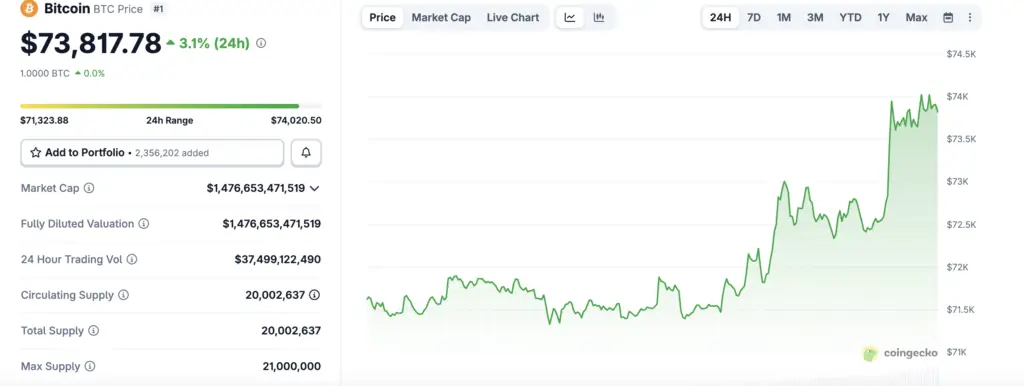
During this period, Bitcoin stabilized near the $70,000 level even as global equity markets struggled. The sequence of events reinforced the idea that cryptocurrency movements can sometimes precede broader market changes.
Similar Trading Patterns Emerging in Equity Markets
Some analysts have noticed that several equity indices are now displaying patterns similar to Bitcoin’s earlier behavior. These markets are experiencing prolonged volatility while remaining close to record levels.
Examples include the SPDR Financial Select Sector ETF, India’s Nifty 50 index, and S&P 500 futures contracts. Each of these markets has traded within wide ranges for several months without establishing clear upward momentum.
This type of sideways volatility previously appeared in Bitcoin before its sharp decline earlier in the year. As a result, some traders are watching these patterns carefully for potential warning signals.
Historical Evidence Supports Bitcoin’s Leading Role
Historical data suggests that Bitcoin has occasionally reversed trends before traditional financial markets. Several notable examples illustrate this pattern over the past decade.
In late 2021, Bitcoin peaked near $60,000 before entering a prolonged decline throughout 2022. Months later, the Nasdaq Composite and the S&P 500 also began falling as the Federal Reserve aggressively tightened monetary policy.
Similar patterns appeared in earlier cycles as well, including the market downturn surrounding the COVID-19 crash. In several cases, Bitcoin lost momentum weeks before equities experienced comparable declines.
Analysts Urge Investors to Monitor Bitcoin Closely
Some investment professionals believe Bitcoin’s growing influence makes it increasingly relevant for equity traders. Todd Stankiewicz of SYKON Capital has noted that Bitcoin frequently peaks before the S&P 500 reverses direction.
According to Stankiewicz, this pattern occurred in late 2017, shortly before the COVID-19 market crash, and again during the 2021 market cycle. In each case, Bitcoin weakened while stock markets continued rising temporarily.
Because of these recurring patterns, analysts suggest investors should watch cryptocurrency markets more closely. Bitcoin’s price movements may offer valuable early clues about future shifts in global financial sentiment.