


Bitcoin’s Price Collapse Signals a Shift in Market Psychology
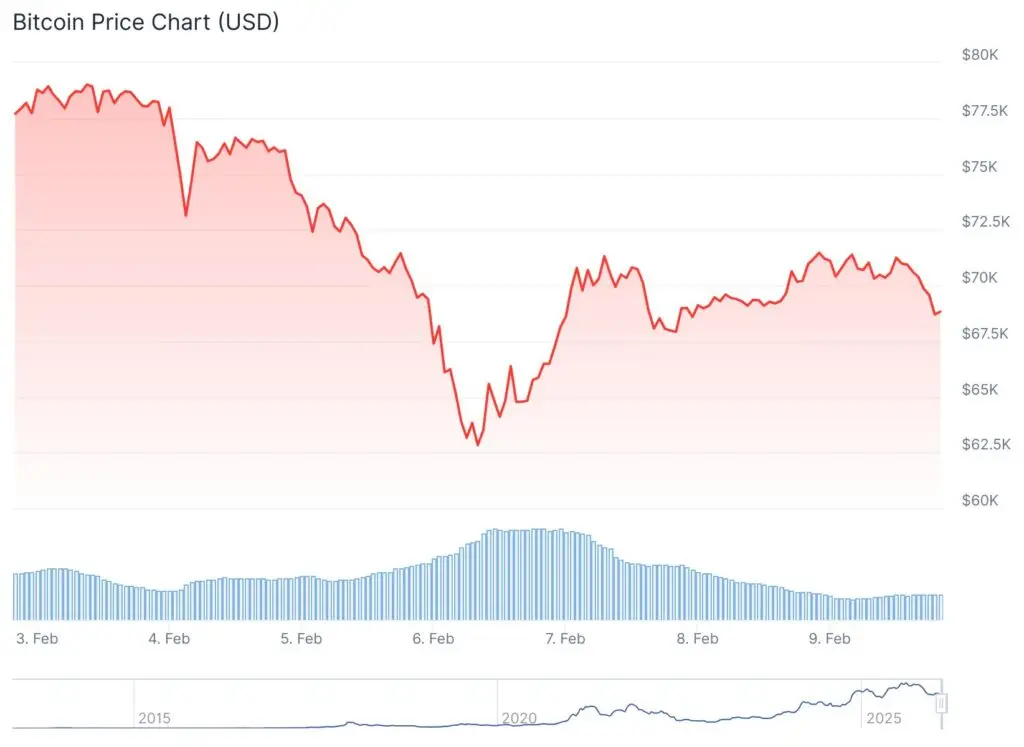
Bitcoin has entered a sharp downward phase, falling to levels not seen in over a year and erasing much of its post-election rally. The decline reflects more than routine volatility, pointing instead to a broader shift in investor psychology and risk appetite.
After peaking above $120,000 in late 2025, Bitcoin has now lost roughly one-third of its value since the start of the year. The speed of the drop has unsettled both retail traders and institutional investors who had positioned for continued upside.
Global Market Stress Is Weighing on Crypto Assets
The sell-off in Bitcoin has unfolded alongside turbulence across global financial markets. Equities, commodities, and precious metals have all experienced heightened volatility as geopolitical tensions and currency uncertainty drive investors toward cash.
Bitcoin, once promoted as a hedge against instability, has instead traded increasingly like a high-risk asset. When liquidity tightens and confidence weakens, speculative positions are often the first to be unwound.
Institutional ETF Flows Have Reversed Direction
One of the most significant drivers of Bitcoin’s decline has been the reversal of institutional flows. U.S.-listed spot Bitcoin exchange-traded funds that accumulated large positions in 2024 are now seeing sustained outflows.
Large-scale selling by ETFs has amplified downward pressure, particularly during low-volume trading periods. As institutional participation retreats, market depth thins, making price swings more severe.
Recommended Article: Bitcoin Extends 2026 Slide as Markets Reprice Crypto Risk
Trump’s Pro-Crypto Agenda Has Limits in Bear Markets
Bitcoin’s surge following the re-election of Donald Trump was fueled by expectations of a friendlier regulatory environment. Trump’s public embrace of digital assets and talk of a strategic crypto reserve boosted sentiment across the sector.
However, supportive rhetoric has proven insufficient to counteract macroeconomic forces. Rising interest rate uncertainty, dollar strength, and global risk aversion have overwhelmed policy optimism in the short term.
Crypto Winter Dynamics Are Re-Emerging
Market participants increasingly describe current conditions as a renewed crypto winter. Trading volumes have fallen sharply, reducing liquidity and making even modest sell orders more disruptive.
As speculative enthusiasm fades, leveraged positions unwind and price discovery becomes more fragile. These dynamics mirror past downturns, where declining participation reinforced prolonged bearish trends.
Ethereum and Altcoins Are Following Bitcoin Lower
The weakness has not been confined to Bitcoin alone. Ethereum and other major cryptocurrencies have recorded double-digit losses, reflecting their dependence on overall market confidence.
Despite Ethereum’s technological role in decentralized finance, its price remains highly correlated with Bitcoin during periods of stress. When capital exits the market, fundamentals offer limited protection.
What Comes Next for the Crypto Market
Historically, crypto winters have eventually given way to renewed growth cycles, often driven by technological progress or shifts in macro conditions. However, recoveries tend to be slow and uneven, testing investor patience.
For now, Bitcoin’s trajectory will likely remain tied to broader financial stability and policy signals from institutions such as the Federal Reserve. Until liquidity returns and risk appetite improves, volatility is expected to remain elevated.