Volatility Trading Moves Into the Mainstream
Crypto market volatility has long been a playground for professional traders using complex derivatives and institutional tools. In early 2026, that dynamic is starting to change. Decentralized prediction platform Polymarket has introduced new contracts that allow everyday users to trade Bitcoin and Ethereum volatility directly, without relying on options desks or sophisticated strategies.
The newly launched markets are tied to Volmex’s 30-day implied volatility indices for Bitcoin and Ethereum. Rather than speculating on whether prices will rise or fall, participants wager on how turbulent price action will become over the course of the year. The shift reflects growing demand for tools that capture uncertainty itself, not just price direction.
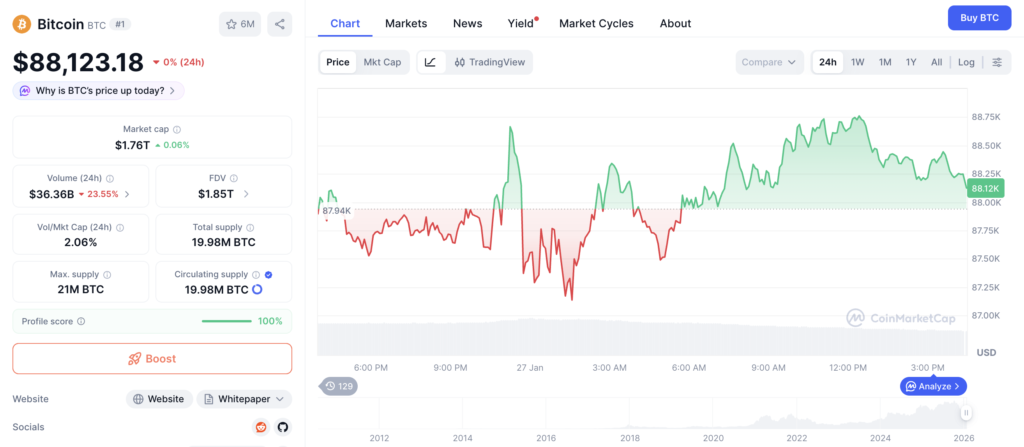
How the New Volatility Contracts Work
Polymarket’s contracts are structured around predefined volatility thresholds. Each market settles based on whether Volmex’s implied volatility index reaches or exceeds a specific level at any point before the end of 2026. If volatility spikes above the target, “Yes” positions pay out. If it does not, the contracts settle “No.”
This structure allows traders to express views on market instability in a simplified format. Instead of constructing multi-leg options strategies or navigating futures markets, users can take a straightforward position on whether volatility will intensify. The contracts measure volatility using one-minute candles, ensuring that even brief spikes are captured.
Early Pricing Signals Elevated Market Uncertainty
Initial trading activity suggests that market participants see a meaningful chance of heightened turbulence. Early pricing implies roughly a one-in-three probability that Bitcoin’s 30-day implied volatility could nearly double from current levels before year-end. Ethereum markets show a similar expectation, with traders assigning significant odds to sharp increases in volatility.
These probabilities reflect broader uncertainty surrounding macroeconomic conditions, regulatory developments, and institutional positioning. Rather than signaling outright bullishness or bearishness, the contracts highlight growing consensus that large price swings may become more frequent in 2026.
Recommended Article: Bitcoin’s Store-of-Value Narrative Tested by Inflation and State Debt
ETFs Have Changed the Volatility Equation
One important backdrop to the new markets is the structural shift caused by spot Bitcoin and Ethereum ETFs in the United States. Since their introduction, implied volatility has shown a more consistently negative correlation with spot prices. In practice, this means volatility spikes are now more often associated with drawdowns rather than rallies.
ETF-driven flows have increased liquidity but also amplified short-term price reactions. Large inflows during risk-on periods are often followed by sharp reversals as institutional traders rebalance. This dynamic makes volatility itself a more distinct and tradable signal than in previous market cycles.
Expanding Access Beyond Institutional Desks
Historically, volatility trading has been dominated by hedge funds, proprietary trading firms, and large asset managers. These players rely on options, variance swaps, and volatility futures that require deep expertise and substantial capital. Polymarket’s approach lowers the barrier to entry by translating institutional-grade volatility benchmarks into an intuitive prediction format.
Industry participants see this as a milestone for crypto derivatives accessibility. By abstracting away complexity, volatility exposure becomes available to a broader audience, potentially deepening market participation while reshaping how traders think about risk.
Betting on Turbulence, Not Direction
The rise of volatility-based markets reflects a broader shift in crypto trading behavior. As the asset class matures, traders are increasingly focused on hedging uncertainty rather than chasing directional bets. Volatility contracts allow users to position for instability regardless of whether prices ultimately rise or fall.
This approach aligns with a market environment shaped by political risk, regulatory uncertainty, and institutional dominance. In such conditions, predicting the magnitude of price swings may be more practical than forecasting precise price trajectories.
What Volatility Markets Signal for 2026
The launch of these contracts underscores how crypto markets are evolving in 2026. Volatility is no longer just a byproduct of speculation but a central feature that traders actively seek to manage or monetize. As more tools emerge that focus on risk rather than price, market structure is likely to continue shifting toward sophistication and institutional alignment.
Whether heightened volatility materializes remains uncertain. What is clear is that traders now have new ways to express that uncertainty, marking another step in crypto’s transition from niche speculation to a more fully developed financial ecosystem.