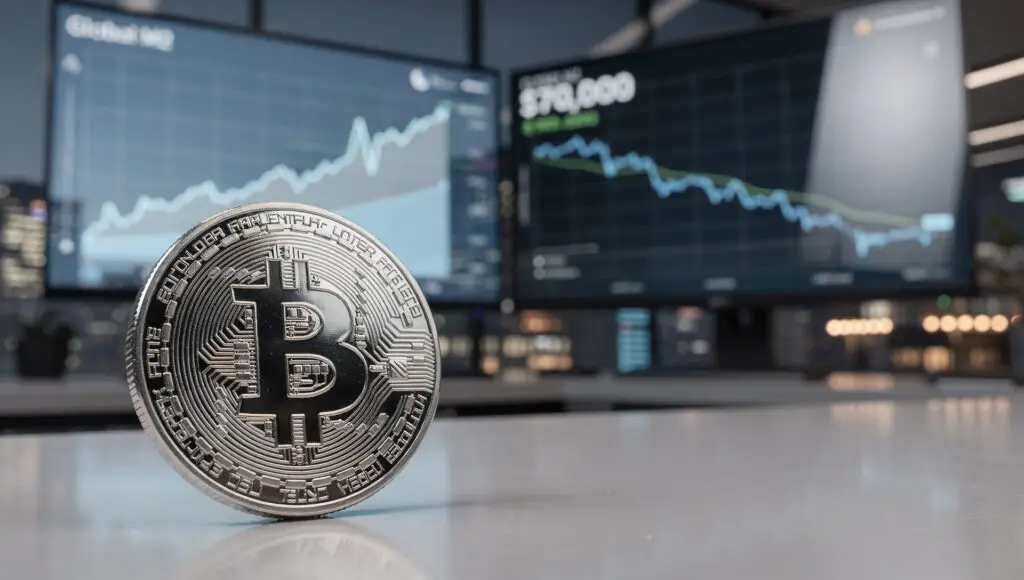


Why Bitcoin’s 2026 Setup Looks Uncomfortable but Constructive
Bitcoin enters 2026 in an unusual position after retreating from record highs reached in mid-2025. Prices have cooled and stabilized rather than collapsing, leaving many investors uncertain about the next move. This environment often creates hesitation because momentum has faded but conviction has not disappeared. Historically, these conditions tend to reward patience rather than aggressive timing.
Bitcoin no longer shows signs of speculative euphoria, yet it also lacks the distress signals seen at true cycle bottoms. Long-term valuation metrics remain below prior extremes, suggesting room for growth. Sentiment indicators reflect caution instead of fear, which often precedes durable accumulation phases. This balance defines why 2026 feels confusing rather than decisive.

Why Trying to Pick the Exact Bottom Rarely Works
Many investors assume successful Bitcoin investing requires pinpointing the perfect entry. In reality, Bitcoin’s history shows that sharp pullbacks are normal even during strong bull cycles. Corrections of 20% to 40% frequently occur without invalidating long-term trends. These drawdowns feel alarming in real time but often resolve quietly.
Past cycles reinforce this lesson. Bitcoin experienced multiple declines exceeding 30% during previous rallies before ultimately reaching higher highs. The recent pullback fits well within those historical norms. Attempting to wait for the lowest possible price often results in missed opportunities or emotional decision-making.
Why Process Beats Prediction in Volatile Markets
Instead of asking whether now is the perfect moment, a better question is how to enter without needing immediate validation. Bitcoin rewards consistency more than precision. A defined process removes the pressure to be right on day one. This approach shifts focus from short-term noise to long-term participation.
Forecasts can provide useful context, but they rarely offer reliable entry signals. Bitcoin’s trajectory depends on macro variables beyond individual control, including liquidity conditions and regulation. Volatility is inevitable regardless of bullish or bearish projections. A disciplined process helps investors survive these swings.
Recommended Article: Grayscale Predicts Bitcoin Will Reach New All-Time High by March…
Dollar-Cost Averaging as a Practical Entry Strategy
Dollar-cost averaging remains one of the most effective tools for navigating uncertainty. By spreading purchases over time, investors reduce exposure to poor timing. If prices decline, later buys occur at lower levels. If prices rise, partial exposure is already established.
This method sacrifices maximum upside in best-case scenarios but protects against worst-case regret. It allows investors to participate without obsessing over short-term price movements. Over long horizons, consistency often outweighs tactical brilliance. For many, this trade-off proves worthwhile.
Why Position Size Matters More Than Entry Price
One of the most common mistakes in Bitcoin investing is allocating too much capital at once. Volatility remains a defining feature despite growing institutional adoption. Large drawdowns are still part of the experience. Allocation size often determines whether volatility feels manageable or overwhelming.
Bitcoin tends to work best as a complementary asset rather than a dominant one. Smaller allocations can meaningfully impact returns without dictating emotional outcomes. Oversized positions frequently lead to panic-driven decisions. Sustainable exposure matters more than chasing optimal prices.
How Platforms and Simplicity Support Long-Term Discipline
Ease of access plays a role in maintaining a process-driven approach. Platforms that integrate Bitcoin alongside traditional financial tools reduce friction. Simpler interfaces discourage constant trading and encourage steady accumulation. This structure aligns well with long-term strategies.
For newer investors, minimizing complexity can be as important as choosing the right entry method. Fewer moving parts reduce behavioral errors. A predictable routine supports discipline when volatility inevitably tests conviction. Structure often determines staying power.
What Actually Defines a Smart Bitcoin Entry in 2026
The best time to buy Bitcoin in 2026 is not a specific day or price level. It is an approach built on patience, modest sizing, and repeatability. Volatility will continue to challenge emotional responses. Those prepared for this reality are better positioned to stay invested.
Bitcoin has consistently rewarded investors who prioritize consistency over clever timing. The real advantage lies in building a strategy that can withstand uncertainty. In 2026, the edge is not prediction. It is process.