


Julian Ross, an electronics engineer who focuses on testing connections and devices over time, sees Apple’s move into satellite features as promising but still dependent on real-world testing. Based on his lab tests, he says these features need to be checked for how reliably they get a signal, how much heat they produce, and how much battery they use over time. He adds that without a stable connection and good battery use, these features may stay limited tools instead of becoming useful for everyday use.
Apple Explores Satellite Infrastructure for iPhone Users
Apple is developing a new suite of satellite-based features for future iPhones, signaling a broader effort to reduce reliance on traditional cellular and Wi-Fi networks. The initiative builds on existing emergency satellite functions and reflects growing industry investment in alternative connectivity infrastructure.
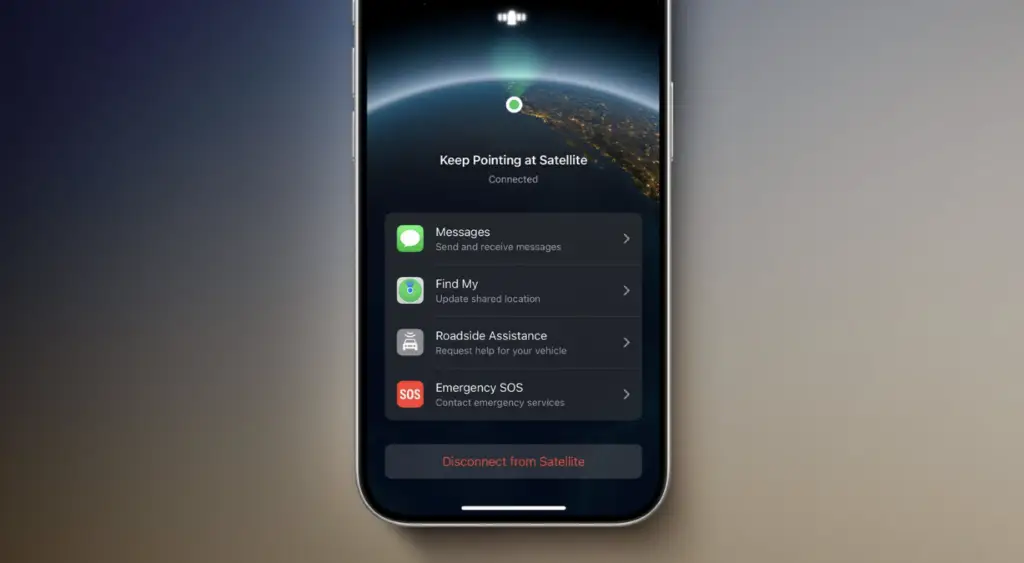
Image source: MacRumors
What new satellite features are being developed?
Apple is reportedly expanding satellite functionality beyond emergency use into more general consumer applications.
Planned capabilities include:
- Satellite-based navigation within Apple Maps
- Photo and message sharing without cellular service
- Enhanced connectivity performance, including limited indoor usability
- Integration between satellite communication and 5G networks
- Developer tools enabling third-party app support
These features aim to transform satellite connectivity from a fallback option into a more integrated part of everyday device use.
How does this differ from current capabilities?
Current iPhone satellite features remain limited and primarily emergency-focused.
Existing functions include:
- Emergency SOS messaging
- Location tracking through Find My
- Basic text communication in remote environments
- Roadside assistance services
The proposed expansion would represent a shift from emergency-only access toward broader, consumer-facing functionality.
How does satellite tech bridge connectivity gaps?
Satellite communication is becoming an increasingly important component of global digital infrastructure.
Across markets:
- Telecom providers are investing in non-terrestrial networks (NTN)
- Technology firms are exploring hybrid connectivity models
- Governments are prioritizing universal coverage initiatives
Organizations such as the International Telecommunication Union are actively developing standards to support satellite-based communication systems.
Who are Apple’s partners in this initiative?
Rather than building its own satellite network, Apple is leveraging partnerships with specialized providers.
Key collaborations include:
- SpaceX for Starlink-based connectivity testing
- T-Mobile for network integration
- Globalstar for existing satellite infrastructure
This approach allows Apple to integrate advanced connectivity features while relying on established telecom networks.
What are the commercial implications?
Apple is expected to adopt a hybrid monetization model for satellite services.
Potential structure includes:
- Free access for essential safety features
- Paid subscription tiers for advanced connectivity
- Revenue-sharing agreements with satellite providers
This aligns with broader industry trends toward subscription-based connectivity services.
What limitations remain?
Despite its potential, satellite connectivity faces several practical constraints.
Key limitations include:
- No support for high-bandwidth services such as voice or video calls
- Limited data throughput compared to cellular networks
- Dependence on partner infrastructure for scalability and coverage
These constraints suggest satellite connectivity will complement, rather than replace, traditional networks.
What risks should be considered?
The expansion introduces multiple technical and market risks.
Key considerations include:
- Reliability risk: Inconsistent signal acquisition in real-world environments
- Battery impact: Increased power consumption during satellite use
- Thermal constraints: Heat generation during sustained transmission
- Adoption risk: Limited use cases for average consumers
From a product standpoint, long-term usability will depend on balancing performance with efficiency.
Satellite Feature Evolution
| Feature | Current Status | Future Impact |
|---|---|---|
| Satellite Messaging | Limited | Expanded use cases |
| Navigation | Not available | Offline capability |
| 5G Satellite | In development | Broader coverage |
| Third-party Apps | Not supported | Ecosystem expansion |
| Pricing Model | Free (basic) | Hybrid monetization |
Satellite Connectivity Moves Toward Practical Adoption
Apple’s move into satellite features shows a bigger change in how devices connect, especially as they start to use mixed network systems. While the technology offers clear benefits like wider coverage and backup connections, its value over time will depend on how well it works in everyday use.
As connectivity becomes a core differentiator in premium devices, the focus is shifting from capability to reliability. For consumers, the question is not whether satellite features work—but how well they perform under everyday conditions.
For Apple and the broader industry, success will depend on translating technical innovation into dependable user experiences. Until then, satellite connectivity remains a promising but still evolving component of the modern mobile ecosystem.