A Quiet Year-End Close for Bitcoin Markets
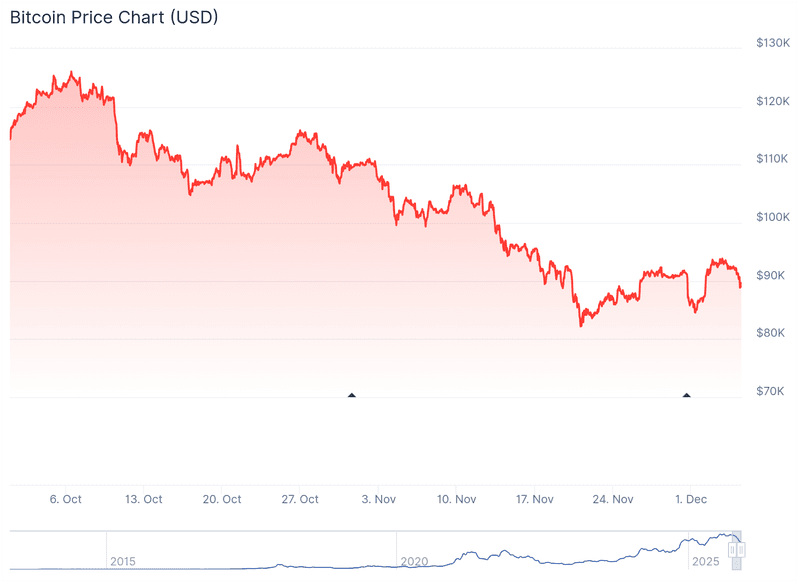
Bitcoin closed the year trading near $87,000 after months of subdued price action. The market drifted through December with little conviction from buyers or sellers. Holiday conditions reduced liquidity across global exchanges. Trading volumes declined steadily as institutional desks stepped back. Price action compressed into a narrow range. Attempts to reclaim higher levels failed repeatedly. The year ended without a decisive trend.
This muted finish contrasted sharply with earlier expectations for 2025. Many investors anticipated sustained upside into year-end. Instead, consolidation defined the final quarter. Short-term traders dominated activity during pullbacks. Long-term holders largely remained inactive. Volatility remained suppressed compared with earlier months. The market appeared stuck in neutral.
Early Optimism Fueled a Strong First-Half Rally
Bitcoin entered 2025 trading in the mid-$90,000 range. Strong inflows into spot exchange-traded funds supported early momentum. Institutional participation expanded rapidly during the first quarter. Corporate treasuries continued accumulating bitcoin exposure. Expectations of easier monetary policy lifted risk assets broadly. Sentiment across crypto markets turned decisively bullish. Price gains accelerated into the summer.
The rally culminated in October with a new all-time high above $125,000. Speculative positioning increased across derivatives markets. Open interest surged as traders chased momentum. Optimism spread across social and institutional channels. Analysts projected further upside before year-end. Confidence in a sustained bull market peaked. That optimism would soon reverse.
Recommended Article: Bitcoin Heads for First Annual Loss Since 2022 as Macro Pressures Mount
Macro Headwinds Reverse Bitcoin’s Trajectory
The fourth quarter introduced tightening financial conditions across markets. Rising bond yields pressured growth and speculative assets. A stronger US dollar reduced appetite for alternative investments. Bitcoin rolled over alongside equities and technology stocks. Selling pressure intensified as macro uncertainty increased. The market began shedding gains accumulated earlier in the year. Momentum faded quickly.
By early December, bitcoin had fallen more than 30% from its peak. The decline unfolded gradually rather than in panic. Each rebound attempt failed to attract follow-through buying. Market participants became increasingly cautious. Risk exposure was reduced across portfolios. Defensive positioning became more common. Price action settled into a defined range.
Persistent Inflation Weighs on Risk Assets
Inflation remained more stubborn than investors expected throughout 2025. Central banks maintained restrictive policies longer than anticipated. High real yields favored cash and fixed-income assets. Speculative markets struggled to attract new capital. Bitcoin’s narrative as an inflation hedge weakened. Marginal buyers hesitated amid macro uncertainty. Demand softened across crypto markets.
This environment limited upside even during short-lived rallies. Investors prioritized capital preservation over growth. Macro data releases frequently triggered sell-offs. Correlations between bitcoin and equities strengthened further. The asset behaved increasingly like a high-risk investment. Structural demand remained intact but muted. Macro pressure dominated price direction.
Liquidity Conditions Tighten Into Year-End
Trading volumes declined sharply during December. Market participation dropped as holidays approached. Institutional desks reduced activity significantly. Retail traders filled much of the remaining volume. Liquidity gaps led to choppy intraday moves. Breakouts lacked confirmation from volume. Price action became range-bound.
Spot ETF inflows slowed noticeably during the final weeks. Without strong inflows, upward momentum stalled. On-chain activity reflected similar stagnation. Long-term holders refrained from aggressive accumulation. Short-term traders dominated flows. Volatility compressed as conviction waned. The market waited for a catalyst.
Structural Progress Continues Beneath Price Weakness
Despite weak price performance, bitcoin’s infrastructure continued to mature. Derivatives markets deepened across major exchanges. Custody solutions improved for institutional investors. Integration with traditional financial systems expanded further. Spot ETFs accumulated tens of billions in assets. These developments anchored long-term demand. Structural growth persisted quietly.
Bitcoin maintained dominance over alternative cryptocurrencies. Relative performance remained stronger than most digital assets. Liquidity remained unmatched within crypto markets. Gold outperformed during periods of macro stress. Still, bitcoin preserved its role as a benchmark asset. Market depth supported orderly trading. The foundation for future cycles remained intact.
What Bitcoin’s Consolidation Means for 2026
As bitcoin enters 2026, the market searches for direction. Traders closely monitor the $90,000 resistance level. Support near the low $80,000s has held repeatedly. A macro shift could unlock renewed momentum. ETF inflows may resume under favorable conditions. Institutional accumulation remains a key variable. Sentiment is cautious but not broken.
The prolonged consolidation reflects market digestion rather than collapse. Excess leverage has largely been cleared. Expectations have reset to more realistic levels. Volatility compression often precedes major moves. The next trend will likely depend on macro catalysts. Bitcoin’s long-term narrative remains intact. For now, patience defines the market.