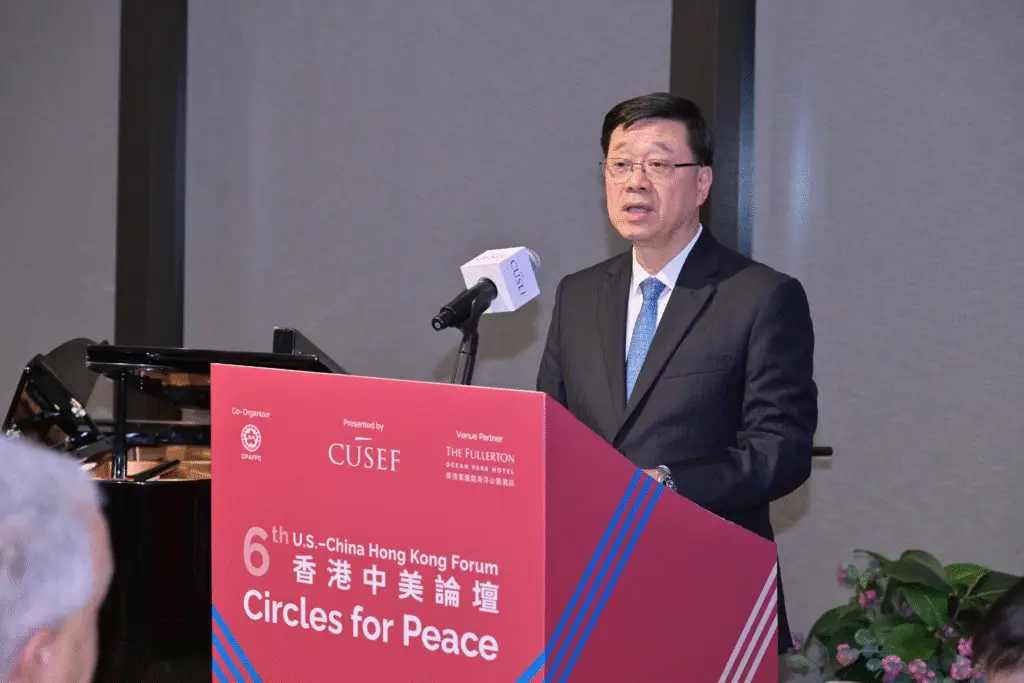
HONG KONG — November 17, 2025 — Artificial intelligence (AI) is poised to become the largest engine of global economic growth, with open-source technologies expected to dominate the next phase of innovation, according to industry leaders at the 6th United States-China Hong Kong Forum.
Executives and scholars agreed that AI’s transformative impact spans every major industry, but warned that a human-centered approach is essential to prevent widening knowledge and opportunity gaps.
Open-Source Models Lead The Next Technological Wave
Kai-Fu Lee, chief executive officer of 01.AI and former president of Google Greater China, described AI as “the world’s next industrial revolution.” He said the technology will drive an unprecedented increase in productivity and efficiency across global industries.
“AI is fundamentally making machines think smarter than we do,” Lee said. “At our company, around 90 percent of all code is written by AI systems, representing a tenfold increase in productivity for engineers worldwide.”
Open-Source Ecosystem Gains Market Dominance
Lee predicted that open-source AI platforms — which allow public access and modification — will soon outpace closed-source models in market share. He compared the trend to the evolution of Linux and Android, which democratized access and innovation in computing.
According to Lee, China’s market share in AI model development has already climbed to 64 percent, while the U.S. share has declined to 30 percent. He said closed-source systems will remain profitable, but open-source frameworks will capture the largest portion of global adoption.
Recommended Article: Vietnam Pushes Inclusive AI Governance To Build Fair Digital Future
AI To Generate Trillions In Economic Value
Forum participants emphasized that AI could add trillions of dollars to the world economy in the coming decade, reshaping industries from manufacturing to healthcare. Lee noted that AI’s ability to blend programming, mathematics, and creative reasoning makes it “a single force capable of surpassing any previous industrial leap.”
Panelists also highlighted AI’s potential to create new categories of employment, as companies pivot toward automation-driven efficiency and high-skill innovation.
Addressing Risks And Inequality In The AI Era
Despite the optimism, experts urged caution regarding ethical, social, and equity challenges. Michelle Williams, professor of epidemiology and population health at Stanford University, said AI must be designed “around principles of equity, transparency, and trust.”
“Our task is to shape AI in ways that close gaps, not widen them,” Williams said, warning that unequal access could deepen educational and economic divides if left unchecked.
Global Collaboration And Responsible Innovation
Williams cited joint initiatives between Peking University and Stanford University that use AI to improve education and healthcare equity. China’s Dual Teaching Classroom program trains rural educators using AI, while Stanford’s research applies AI tools to help doctors in under-resourced areas.
“These examples show how international cooperation can make AI a force for inclusion,” Williams added. “If we focus on responsibility and human benefit, AI can empower rather than displace.”
Human-Centered Development As The Foundation
The forum’s theme, Circles for Peace, underscored the importance of human-centered AI development to foster global harmony and innovation. Participants concluded that balancing technological progress with ethical stewardship will determine whether AI remains an ally or becomes a threat.
As nations race to regulate and deploy artificial intelligence, the consensus among attendees was clear: AI will define the next era of global prosperity — but only if guided by fairness, transparency, and shared responsibility.