K-Shaped Pattern Highlights Diverging Financial Paths in the United States
The K-shaped economy describes a divide where wealthy Americans enjoy rising incomes while others face stagnation. Analysts say the pattern explains strong markets existing alongside widening financial pressures.
Economists note that this divide complicates interpretations of broader economic performance. Traditional indicators appear strong, yet many families continue struggling with basic living costs.
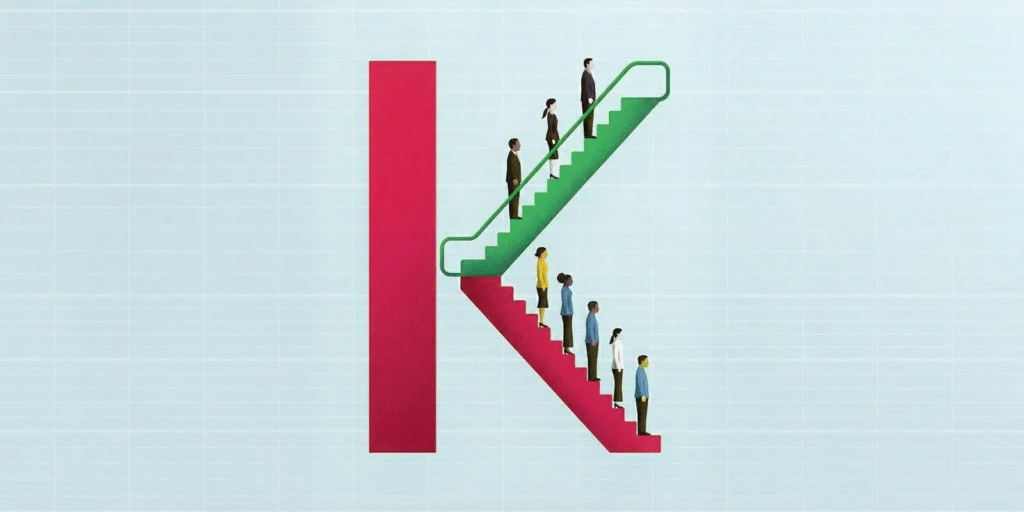
Source: How to invest in a K-shaped economy – Finimize
Consumer Behavior Shows Clear Differences Across Income Groups Nationwide
Higher-income households maintain spending on travel, technology, and premium goods during uncertain times. Their financial stability supports industries targeting luxury markets and discretionary purchases.
Lower-income groups remain far more cautious as wage gains slow and prices remain elevated. Many households reduce nonessential spending and increasingly depend on credit to manage daily expenses.
Corporate Leaders Adjust Strategies Based on Shifting Income Dynamics
Companies are reshaping product lines to reach both affluent buyers and budget-conscious consumers. Executives acknowledge that diverging income trends require flexible pricing strategies and new market approaches.
Premium offerings continue to drive profits among wealthier segments with strong purchasing power. Meanwhile, smaller package sizes and discount options address financial constraints affecting middle- and lower-income customers.
Recommended Article: South Korea Faces Deepening Polarization One Year After Martial Law Crisis
Wealth Effects Intensify the Divide as Markets Favor Affluent Investors
Stock gains benefit wealthy households disproportionately because they hold most market assets. Rising share prices amplify existing wealth gaps and contribute to the economy’s uneven trajectory.
Lower-income Americans own a minimal share of financial markets, limiting long-term growth potential. This imbalance intensifies pressures as essential costs rise faster than their income levels.
Labor Market Shifts Reveal Uneven Wage Growth Across Multiple Sectors
Post-pandemic wage trends initially favored lower-income workers during a tight labor market. Employers boosted pay to attract staff quickly, narrowing gaps temporarily across industries.
Recent hiring slowdowns weakened momentum and pushed wage growth downward for vulnerable groups. Higher-income workers maintained stronger wage gains while others struggled to keep pace with inflation.
AI Expansion Fuels Market Strength but Lacks Broad Economic Spillover
Artificial intelligence investment boosts stock valuations for major technology firms. These gains contribute significantly to upper-income wealth accumulation and widen economic disparities.
However, AI-driven growth creates relatively few jobs compared with traditional industries. Limited spillover effects leave many workers excluded from benefits associated with emerging technologies.
Economists Warn of Potential Risks If Inequality Continues Worsening
Experts caution that an economy driven mainly by wealthy consumer spending may become unstable. Rising unemployment or stalled wage growth could quickly weaken broad-based demand nationwide.
Analysts suggest that future tax adjustments and interest rate shifts may influence spending behavior. Policymakers may need targeted measures to reduce inequality and strengthen overall economic resilience.