WASHINGTON — December 8, 2025 — President Donald Trump has authorized Nvidia to sell its advanced H200 artificial intelligence chips to selected commercial customers in China, reversing earlier restrictions while insisting the policy preserves national security and strengthens American industry. The move follows months of lobbying from Nvidia CEO Jensen Huang, whose firm has been at the center of a widening US–China technology rivalry.
The announcement marks a significant shift in Washington’s approach to AI chip exports, raising new questions from lawmakers and analysts about the national security implications of allowing Beijing access to high-performance semiconductors.
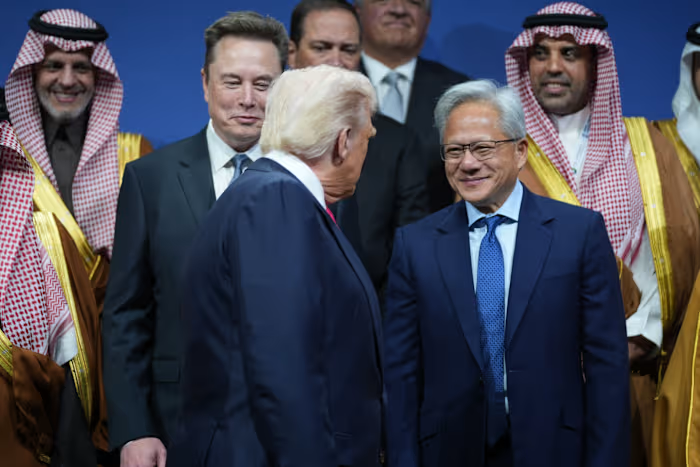
Trump Reverses AI Chip Ban While Imposing New Revenue Conditions
The White House decision lifts a ban introduced earlier this year that prevented Nvidia, AMD, and other US companies from selling their most advanced chips to China. Trump said on social media that the policy will “protect National Security, create American Jobs, and keep America’s lead in AI,” adding that Nvidia will pay a percentage of its Chinese revenue to the US government.
Nvidia confirmed the approval, saying the agreement allows the company to compete globally while maintaining safeguards set by the Department of Commerce. The H200 chip, a generation behind Nvidia’s flagship Blackwell semiconductor, will be restricted to vetted commercial clients.

Nvidia Welcomes Shift as China Pushes to Reduce Dependence on US Tech
Nvidia praised the decision as a balanced approach that maintains American competitiveness. The company’s stock rose modestly following the announcement. CEO Jensen Huang has long argued that the United States must ensure global access to AI technology while maintaining security controls, warning that China’s domestic chip development is advancing quickly.
Beijing has previously encouraged local technology firms to avoid Nvidia’s H20 chips and purchase domestically manufactured alternatives, part of its broader strategy to reduce reliance on US semiconductor suppliers.
Recommended Article: Meta Expands AI Assistant With Major News Partnerships Across Global…
Export Approval Likely to Face Pushback From Security Hawks
Members of Congress are expected to challenge the policy, citing concerns that advanced semiconductors could be diverted to China’s military. Researchers at Georgetown University’s Center for Security and Emerging Technology say Chinese defense institutions have used high-performance chips from US companies to develop AI-enabled military systems.
Analysts warn that easing access to powerful AI chips could accelerate China’s military modernization, as the People’s Liberation Army expands its use of machine-learning tools for intelligence, targeting, and battlefield logistics.
Policy Aims to Buy Time for Negotiations Over Rare Earth Dependencies
Experts say the decision may be part of a tactical strategy to stabilize supply chains while the US negotiates with Beijing over critical minerals. China controls a near-monopoly over rare earth processing, which is essential to producing semiconductors, electric motors, and other advanced technologies.
Alex Capri of the National University of Singapore said the chip approval “buys time” for both sides to avoid disruptions in industries that rely heavily on rare earth inputs.
China Expected to Continue Pursuit of Semiconductor Self-Sufficiency
Although approved companies in China will gain access to the H200, analysts expect Beijing to accelerate efforts to cultivate a fully domestic chip ecosystem. Chinese regulators have already instructed local firms to reduce foreign technology purchases and expand adoption of homegrown processors.
Huang and other industry leaders have warned that restricting China’s access too aggressively risks encouraging the development of competing ecosystems that could eventually challenge US dominance.
Military Implications Raise Stakes in US–China Technology Rivalry
National security analysts argue that allowing China to obtain higher-quality chips could enhance its military AI capabilities, particularly in autonomous systems, cyber operations, and strategic decision-making tools. US policymakers remain divided over whether commercial restrictions meaningfully constrain Beijing’s military progress.
Cole McFaul of CSET said that providing China access to H200 chips would “enable more sophisticated battlefield AI applications,” adding that the long-term strategic implications require careful evaluation.
Geopolitical and Economic Consequences Continue to Unfold
The administration has not yet clarified the financial arrangements tied to the export approval, which Trump described as a percentage payment of Chinese revenues to the US. The policy remains under review, and industry observers expect intense debate as lawmakers assess whether the revised export rules benefit national security or compromise it.
The decision highlights the growing complexity of US semiconductor policy, balancing economic competitiveness, security concerns, and global supply chain stability amid one of the most consequential technological rivalries of the century.