Signs of Slowing Momentum
China’s economic performance weakened further in November, highlighting challenges across multiple sectors. Official data showed a notable slowdown in consumer spending, adding to concerns about domestic demand.
Retail sales growth fell to its lowest level since 2022, signaling that households remain cautious despite government efforts to stimulate consumption. The slowdown underscores fragile confidence among Chinese consumers.
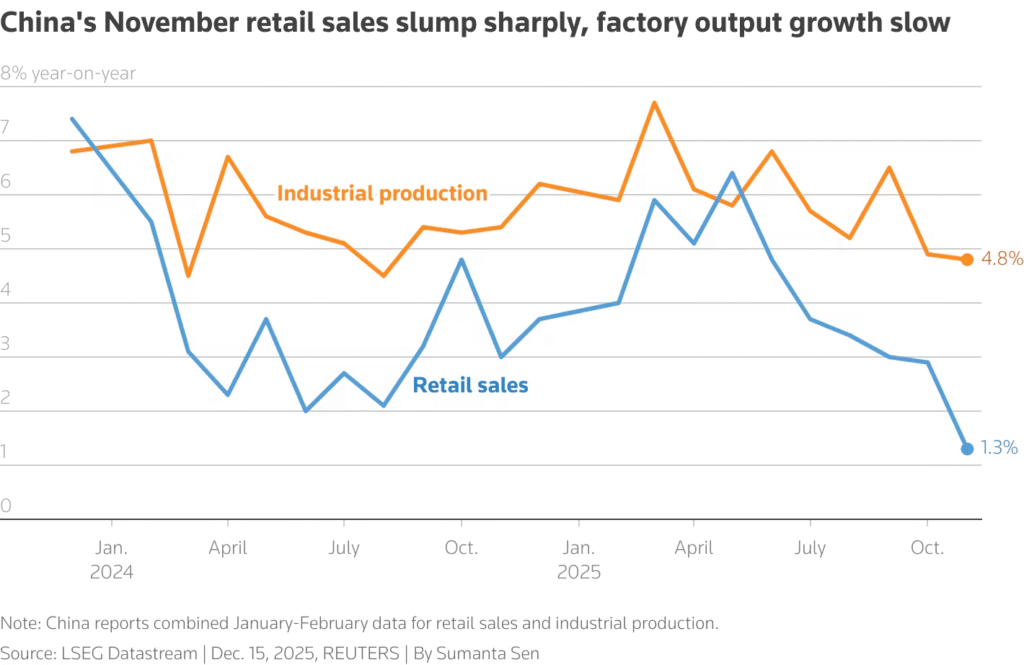
Source: China’s economy stalls in November as calls grow for reform | Reuters
Consumer Spending Under Pressure
Weak retail figures suggest households are prioritizing savings over discretionary spending. Lingering uncertainty around employment prospects and income growth continues to weigh on consumer behavior.
This cautious mindset limits the effectiveness of stimulus measures, as consumers remain hesitant to increase spending even when conditions slightly improve.
Investment Loses Momentum
Fixed-asset investment also showed signs of deterioration, reflecting subdued business confidence. Companies appear reluctant to expand capacity amid uncertain demand and tightening profit margins.
Private sector investment has been particularly soft, raising concerns about long-term growth potential. Without stronger confidence, investment-driven recovery remains difficult.
Recommended Article: China Economic Outlook Strengthens as 2025 Growth Surpasses Expectations
Property Sector Remains a Drag
China’s real estate market continues to struggle, exerting a heavy toll on the broader economy. Property development has long been a cornerstone of growth, making its prolonged downturn especially damaging.
Developers face weak sales, heavy debt burdens, and falling prices. These challenges ripple outward, affecting construction activity, employment, and local government revenues.
Employment Stability Masks Deeper Issues
China’s urban unemployment rate held steady at 5.1 percent in November, offering some reassurance. However, headline stability conceals ongoing challenges beneath the surface.
Youth unemployment and underemployment remain persistent concerns, particularly for recent graduates entering a slowing labor market with limited opportunities for advancement.
Growing Pressure on Policymakers
The latest economic data increases pressure on Beijing to act decisively. Authorities face calls to boost household demand, stabilize property markets, and restore business confidence.
At the same time, policymakers must navigate debt risks and avoid overstimulating sectors already burdened by excess capacity and financial strain.
Balancing Short-Term Support and Long-Term Reform
China’s leadership has signaled willingness to provide targeted support rather than sweeping stimulus. The goal is to stabilize growth while preventing long-term imbalances from worsening.
Structural reforms, including improving social safety nets and encouraging private enterprise, are increasingly seen as necessary for sustained recovery.
Global Consequences of China’s Slowdown
As the world’s second-largest economy, China’s slowdown carries international implications. Reduced demand affects global trade, commodity prices, and supply chains.
Countries reliant on Chinese consumption and investment are closely monitoring Beijing’s next moves, aware that policy shifts could ripple across global markets.
An Uncertain Path Forward
China’s economic challenges appear increasingly structural rather than temporary. Restoring confidence among consumers and businesses will require more than short-term fixes.
The coming months will test whether policymakers can stabilize growth while reshaping an economy facing mounting internal and external pressures.