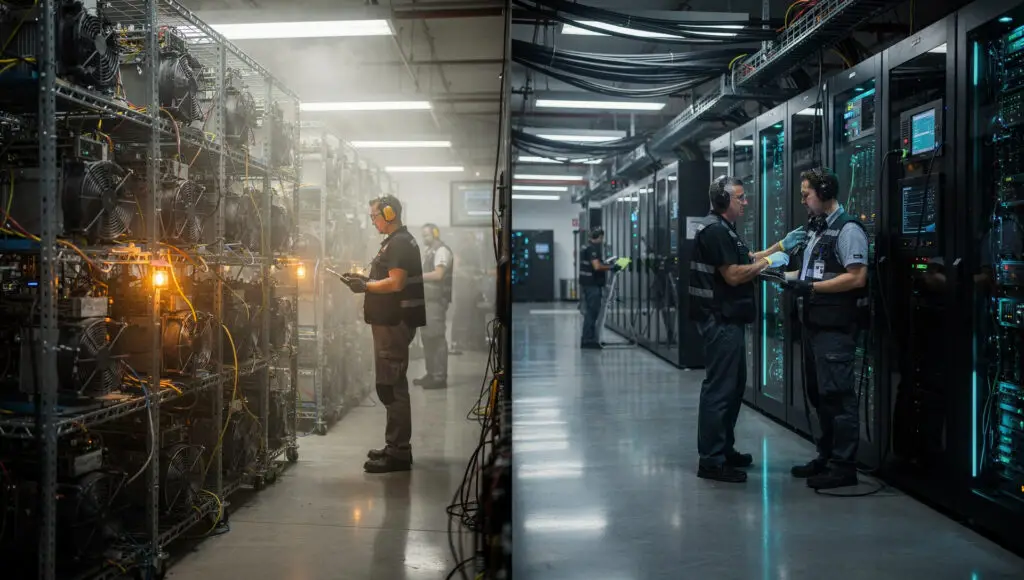
Bit Digital Signals Strategic Break From Bitcoin Mining
Bit Digital has announced plans to fully wind down its Bitcoin mining operations, marking a decisive strategic shift for one of the industry’s early public miners. The company, which entered Bitcoin mining in 2020, said the move reflects changing capital efficiency dynamics across the digital asset sector.
Chief executive Sam Tabar described mining as an increasingly inefficient use of capital compared with opportunities in Ethereum infrastructure and high-performance computing. The announcement underscores how rising energy costs, competition, and thinner margins are forcing miners to rethink long-term viability.

Ethereum Becomes the Core Treasury Asset
As Bitcoin mining winds down, Bit Digital is consolidating its digital asset exposure around Ethereum. The firm holds more than 150,000 ETH, the majority of which is staked, positioning Ethereum as both a treasury asset and a yield-generating instrument.
Ethereum’s proof-of-stake model allows Bit Digital to earn staking rewards without the operational overhead associated with mining. This shift reflects a broader industry trend in which firms seek predictable returns rather than exposure to volatile mining economics tied to energy markets and hardware cycles.
Brock Pierce’s Influence Shapes the Pivot
The strategic realignment carries the backing of Brock Pierce, who has increased his exposure to Bit Digital through personal investment and board involvement. Pierce, a long-time crypto advocate and Tether co-founder, has emphasized Ethereum’s role as foundational infrastructure for decentralized finance and digital settlement.
Pierce’s support has reinforced investor confidence in the company’s pivot, signaling belief that Ethereum-based strategies offer greater durability than Bitcoin mining in a post-proof-of-work-dominant era.
Recommended Article: Wall Street Doubles Down on Ethereum as Institutional Buying Accelerates
Exit Reflects Broader Mining Industry Pressures
Bit Digital’s retreat highlights mounting pressures facing Bitcoin miners globally. Rising hash rates, regulatory scrutiny, and volatile electricity pricing have squeezed profitability, even for publicly listed firms with access to capital markets.
While some miners are doubling down on scale to survive, others are exiting altogether. Bit Digital’s decision suggests that diversification, rather than consolidation, may offer a more sustainable path for companies seeking long-term relevance in the crypto economy.
AI and High-Performance Computing Take Center Stage
Beyond Ethereum, Bit Digital is accelerating its push into artificial intelligence and high-performance computing through its majority stake in WhiteFiber. The subsidiary focuses on infrastructure designed to support AI workloads, data-intensive applications, and enterprise computing demand.
WhiteFiber’s recent public offering has given Bit Digital exposure to a sector benefiting from surging AI investment. Management views this business as a strategic asset aligned with long-term growth in automation, data processing, and enterprise technology.
Capital Markets Favor Productive Infrastructure
The pivot reflects a broader shift in how capital markets value crypto-related companies. Investors increasingly favor firms that operate productive infrastructure capable of generating recurring revenue, rather than relying on speculative asset appreciation.
Ethereum staking and AI computing both fit this profile. By combining yield-generating digital assets with physical infrastructure supporting AI, Bit Digital aims to position itself at the intersection of blockchain and next-generation computing.
Ethereum’s Role in Institutional Strategy Expands
Bit Digital’s move also underscores Ethereum’s growing role in institutional strategy. Unlike Bitcoin, which primarily functions as a store of value, Ethereum supports applications ranging from tokenization to decentralized finance and enterprise settlement.
Large financial institutions have already identified Ethereum-compatible networks as preferred platforms for blockchain adoption. Bit Digital’s consolidation around ETH aligns the firm with that institutional trajectory, even as market volatility persists.
What the Shift Means for Crypto Companies
Bit Digital’s decision to abandon Bitcoin mining reflects a broader evolution within the crypto sector. Early business models built around proof-of-work mining are giving way to strategies focused on infrastructure, yield, and enterprise relevance.
While Bitcoin remains central to the crypto ecosystem, mining is no longer the default path for public companies seeking growth. For Bit Digital, the future lies in Ethereum, AI, and infrastructure that compounds value over time. The success of this pivot will be closely watched by investors evaluating which crypto-native firms can adapt as the industry matures.