

Bitcoin Gains While Traditional Markets Struggle
Bitcoin has shown surprising strength since the outbreak of the Iran conflict, outperforming several traditional financial assets. While geopolitical tensions often trigger widespread market volatility, the cryptocurrency has managed to post gains during this uncertain period.
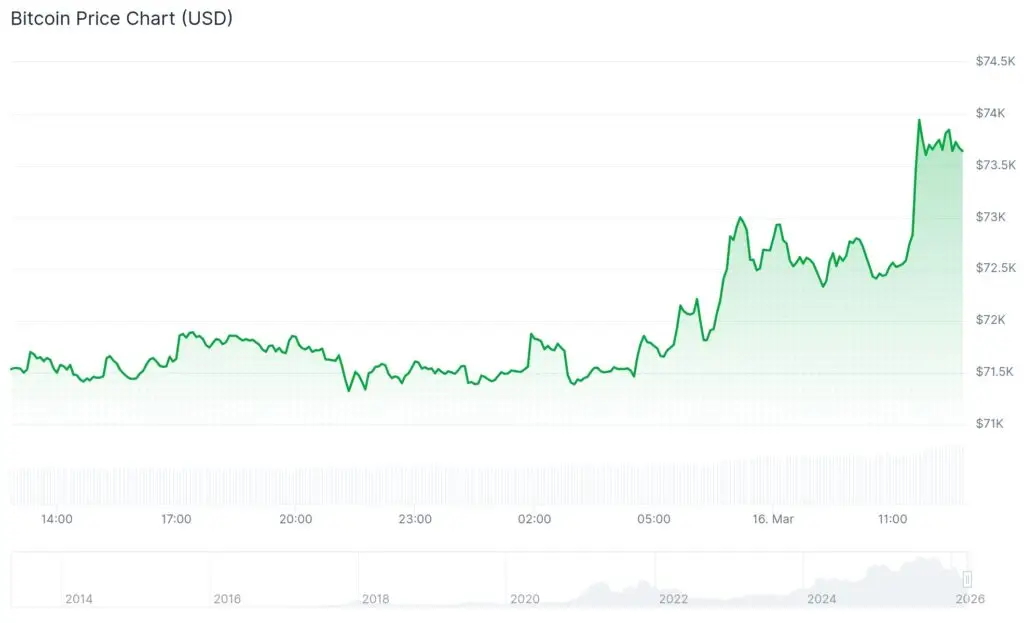
Since the war began in late February, Bitcoin has climbed steadily even as global equities weakened. The digital asset rose roughly 5% in a single week, with most of the gains occurring within a short twenty-four hour window.
This performance contrasts sharply with traditional markets that have faced downward pressure. Investors are now reconsidering Bitcoin’s potential role as a diversification tool during periods of geopolitical instability.
S&P 500 and Nasdaq Face Declines
While Bitcoin moved higher, major stock indices have struggled to maintain momentum since the conflict began. The S&P 500 and other major benchmarks have posted noticeable declines amid rising geopolitical uncertainty.
The technology-heavy Nasdaq Composite index has also moved lower as investors reduce exposure to risk assets. Technology stocks often react strongly to changes in global economic sentiment, making them particularly vulnerable during geopolitical crises.
Meanwhile, safe-haven assets such as gold have not delivered strong returns either. The metal has declined alongside equities, highlighting Bitcoin’s unusual performance during the recent market turmoil.
Geopolitical Tensions Reshape Investment Strategies
The Iran conflict has created significant uncertainty across global financial markets. Energy prices have surged, while investors are closely monitoring potential disruptions to oil supply routes in the Middle East.
When geopolitical tensions escalate, investors often rebalance their portfolios to reduce exposure to risk. In previous crises, this process typically involved moving capital into assets like gold or government bonds.
However, Bitcoin’s recent performance suggests it may increasingly play a role in diversification strategies. Some investors now view digital assets as an alternative store of value during periods of global instability.
ETF Managers Highlight Bitcoin’s Diversification Role
Investment professionals appearing on financial television programs have pointed to Bitcoin’s resilience during the crisis. Simeon Hyman, global investment strategist at ProShares, emphasized that the cryptocurrency has performed differently from equities.
According to Hyman, Bitcoin’s ability to gain value while stocks decline supports its diversification narrative. Assets that move independently from traditional markets can help investors reduce overall portfolio risk.
This perspective has gained attention as institutional investors continue exploring cryptocurrency exposure through exchange-traded funds. The growth of crypto ETFs has helped integrate digital assets more deeply into mainstream financial markets.
Crypto ETFs Continue Expanding
The cryptocurrency investment industry has expanded significantly in recent years, particularly through exchange-traded funds. Asset management firms now offer a growing range of crypto-related investment products.
ProShares recently launched the CoinDesk 20 Crypto ETF, designed to track a basket of leading digital assets. The fund has gained nearly five percent since the Iran conflict began, mirroring broader improvements in crypto prices.
Despite these gains, the ETF has experienced volatility since its launch earlier this year. Market uncertainty and fluctuating crypto prices have affected investor sentiment toward these new financial instruments.
Bitcoin Still Recovering From Previous Peak
Although Bitcoin has shown strength during the current geopolitical crisis, it remains significantly below its historical peak. The cryptocurrency reached an all-time high above $126,000 last October before entering a steep decline.
At present, Bitcoin trades more than forty percent below that record level. The correction has led some analysts to describe the current market phase as a typical “crypto winter.”
These cycles have historically occurred every few years within the cryptocurrency market. Periods of rapid growth are often followed by extended corrections before the next major rally begins.
Analysts Debate the Future of Bitcoin’s Cycle
Market experts remain divided over Bitcoin’s long-term trajectory following its recent rebound. Some believe the digital asset is entering the final stage of the current downturn before beginning a new upward cycle.
Kim Arthur, founding partner and chief executive of Main Management, described the current period as a classic bottoming phase. According to him, the market is stabilizing after a significant decline from last year’s peak.
Other investors remain cautious and prefer a passive investment strategy while the market stabilizes. Regardless of short-term volatility, Bitcoin continues attracting attention as a benchmark for the broader digital asset market.