Bitcoin Rises Even As Global Markets Show Weakness
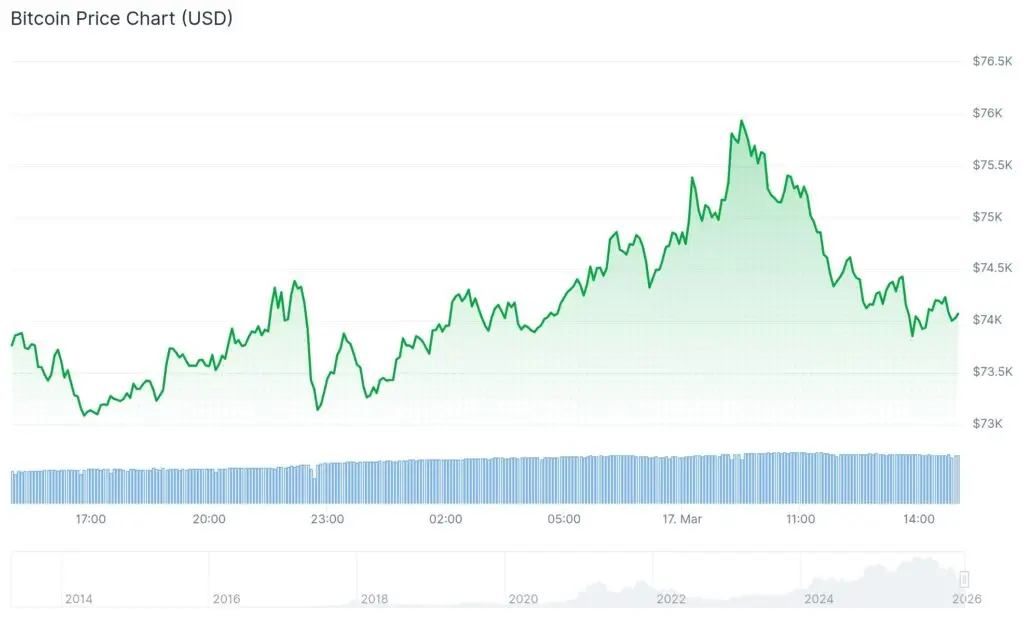
Bitcoin has climbed to its highest level in a week, reaching around $71,500 despite broader market instability. This rise comes as global equities decline amid escalating geopolitical tensions in the Middle East.
Major stock indices, including the S&P 500 and Nasdaq, have recorded noticeable losses during this period. In contrast, Bitcoin has managed to recover some recent losses, signaling potential divergence from traditional assets.
This performance suggests that Bitcoin may not always move in tandem with global financial markets. Investors are increasingly watching whether crypto can act independently during macroeconomic stress.
Oil Price Surge Adds Pressure To Global Economy
Oil prices have surged sharply due to fears surrounding supply disruptions in the Strait of Hormuz. Brent crude jumped over 9%, surpassing $100 per barrel for the first time in years.
The Strait of Hormuz is a critical shipping route responsible for a significant portion of global oil transport. Any disruption in this region can have immediate and far-reaching economic consequences.
Higher energy prices increase inflationary pressure and raise costs for businesses and consumers. This environment typically weighs on risk assets, making Bitcoin’s resilience more notable.
Geopolitical Uncertainty Drives Market Volatility
Ongoing tensions involving the United States, Israel, and Iran have intensified uncertainty across financial markets. Investors remain cautious as the situation evolves and risks of prolonged conflict persist.
Statements from political leaders have further influenced market sentiment, particularly regarding priorities beyond economic concerns. These developments contribute to heightened volatility across asset classes.
Geopolitical instability often triggers shifts in capital allocation as investors seek safer or more resilient assets. Bitcoin’s performance during this period is being closely monitored as a result.
Crypto Specific Demand Supports Bitcoin Price
Analysts suggest that Bitcoin’s recent strength may be driven by internal market dynamics rather than macroeconomic factors. Increased demand within the crypto ecosystem is helping support prices.
One example is the growing interest in yield-generating products tied to Bitcoin exposure. These financial instruments are attracting significant capital inflows from investors seeking returns.
Such demand creates consistent buying pressure that can offset negative macroeconomic influences. This internal support may explain why Bitcoin is outperforming traditional markets in the short term.
Institutional Buying Adds Momentum To Recovery
Large-scale purchases by institutional players have also contributed to Bitcoin’s recent price movement. Investment firms continue to accumulate Bitcoin as part of long-term strategies.
Recent acquisitions worth billions of dollars highlight sustained confidence among major investors. These moves often influence market sentiment and encourage additional participation.
Institutional activity plays a crucial role in shaping market trends. Their involvement provides liquidity and can stabilize prices during periods of uncertainty.
Liquidity Conditions Remain Key Market Driver
Global liquidity remains one of the most important factors affecting Bitcoin’s price direction. Analysts emphasize that liquidity conditions often outweigh short-term geopolitical events.
If central banks maintain or increase liquidity in financial systems, risk assets like Bitcoin could benefit. Conversely, tightening liquidity may put downward pressure on prices.
Investors are closely watching central bank policies and economic indicators for signals. These factors will likely determine the sustainability of Bitcoin’s recent gains.
Future Outlook Depends On Conflict And Economy
The future trajectory of Bitcoin will depend heavily on how geopolitical tensions unfold. A prolonged conflict could disrupt markets further and impact investor confidence.
If the situation stabilizes, Bitcoin may continue to recover and build momentum. However, renewed volatility could lead to additional price fluctuations in the near term.
Ultimately, Bitcoin’s resilience during this period highlights its evolving role in global finance. Whether it can sustain this independence remains a key question for investors.