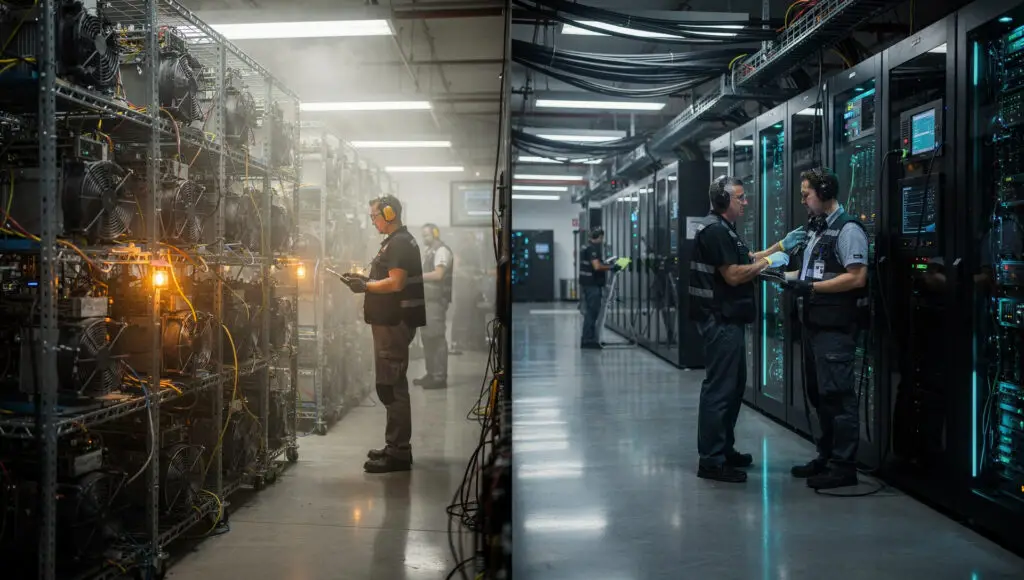
Aris Kristoff, an AI researcher specializing in large language model alignment and system reliability, identifies Europe’s primary constraint in the global AI race as a structural imbalance between talent and infrastructure. Drawing from his experience in model evaluation and red-teaming, Kristoff explains that insufficient compute capacity directly limits the ability to train, test, and validate advanced AI systems. He emphasizes that even well-aligned models cannot achieve competitive performance or reliability without scalable and continuous access to high-performance computing resources.
Nvidia Executive Warns Europe Risks Falling Behind in AI Race
A senior executive from Nvidia has warned that Europe risks falling behind in the global artificial intelligence race unless it significantly expands its infrastructure and energy capacity. The comments reflect growing concern among industry leaders that Europe’s development pace may lag behind that of the United States and China.
Image source: RCR Wireless
What is holding Europe back in AI development?
According to Rev Lebaredian, Europe’s primary limitation is not talent but infrastructure readiness.
Key constraints include:
- Insufficient large-scale AI data centers (“AI factories”)
- High energy costs relative to global competitors
- Limited compute capacity for advanced model training
Without these foundational components, progress in AI development may be constrained regardless of technical expertise.
Why are “AI factories” and energy critical?
AI systems require substantial computational resources, which depend on both physical infrastructure and reliable energy supply.
The European Commission has committed to expanding AI infrastructure through the development of specialized data centers across the region.
However, several challenges persist:
- Energy-intensive workloads placing pressure on existing grids
- Scaling requirements for renewable and nuclear energy sources
- Cost competitiveness lagging behind other global regions
Energy availability is increasingly viewed as a core determinant of AI competitiveness.
How is AI driving economic growth across Europe?
Artificial intelligence is becoming a central driver of economic growth, productivity, and industrial competitiveness across Europe.
Key implications include:
- Government investment in sovereign AI capabilities
- Integration of AI across manufacturing, services, and logistics
- Ongoing balance between innovation and regulatory oversight
Europe’s ability to scale infrastructure will determine whether it maintains technological independence or becomes reliant on external providers.
What is the next frontier of AI according to Nvidia?
Beyond generative AI, Nvidia is focusing on “physical AI,” encompassing robotics, automation, and real-world system integration.
Key developments include:
- Deployment of robots in industrial environments
- Automation of labor-intensive sectors
- Integration of AI into logistics and manufacturing systems
These applications address structural challenges such as labor shortages and demographic shifts.
How realistic is widespread robotics adoption?
While industrial deployment is advancing, consumer-level adoption remains more complex.
Key challenges include:
- High costs associated with hardware and deployment
- Safety concerns in dynamic, unstructured environments
- Variability in demand across different markets
Industrial settings, by contrast, provide controlled environments that are more suitable for scaling and testing.
What role does autonomous driving play?
Nvidia is also expanding into autonomous mobility through partnerships and simulation-driven development.
Key elements include:
- Simulation-based testing in virtual environments
- Data-driven training for safety optimization
- Gradual deployment in controlled geographic regions
Regulatory frameworks and infrastructure readiness remain critical to broader adoption.
What risks should investors and policymakers consider?
Despite strong growth potential, several structural risks could affect Europe’s position in the AI ecosystem.
Key considerations include:
- Infrastructure risk from delays in data center expansion
- Energy risk linked to rising costs and supply constraints
- Regulatory risk from fragmented policies across EU member states
- Adoption risk due to slower commercialization timelines
These factors may influence Europe’s ability to compete effectively in the global AI market.
Europe in the Global AI Landscape
| Factor | Europe Status | Global Comparison |
|---|---|---|
| AI Infrastructure | Expanding | Behind US/China |
| Energy Costs | High | Less competitive |
| Talent Pool | Strong | Competitive |
| Robotics Adoption | Emerging | Growing globally |
| Regulation | Strict | More flexible elsewhere |
Europe’s AI Future Hinges on Execution
Europe’s position in the global AI race will depend less on innovation alone and more on execution—particularly its ability to scale infrastructure and secure affordable energy. While the region retains strong technical expertise and regulatory leadership, closing the gap with global competitors will require sustained investment, coordinated policy, and strategic alignment between industry and government.
Without addressing compute and energy constraints, Europe risks limiting the performance, reliability, and global competitiveness of its AI systems in an increasingly infrastructure-driven landscape.